
Let’s be honest: most digital signs are just glorified posters. They loop the same videos or cycle through the same graphics, broadcasting a one-way message into the void. We see them in hotel lobbies, retail stores, and airports, and most of the time, we tune them out. But what if that screen could see you, understand you, and talk back? What if it could answer your specific questions, in your language, right now? That’s the revolutionary promise of AI digital signage.
This isn’t science fiction anymore. It’s a powerful new tool that’s transforming passive displays into active, helpful, and engaging team members. In this article, we’ll dive into what AI digital signage is, how it works, and how you can use it to create unforgettable customer experiences.
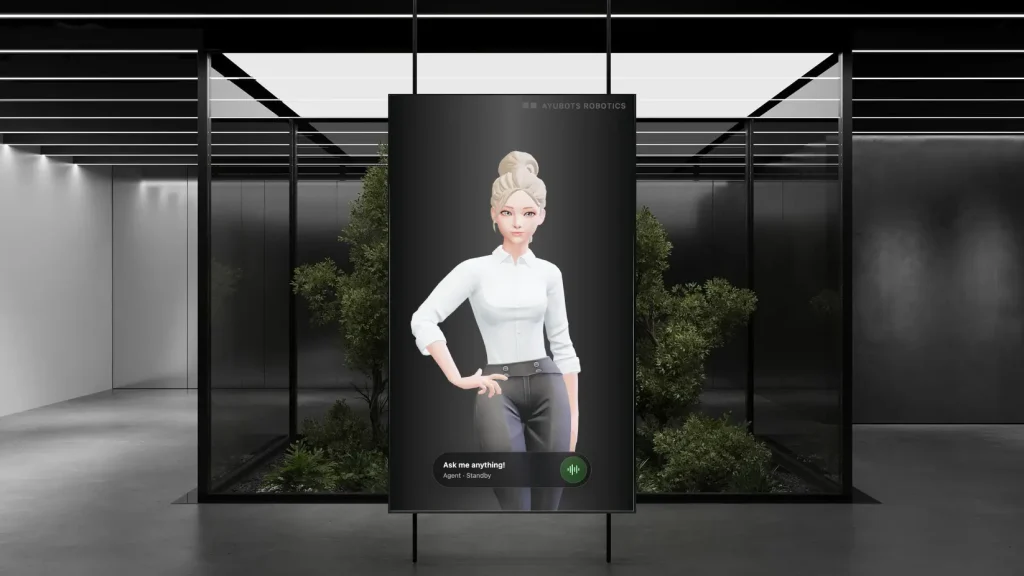
From Static Displays to Smart Conversations
Traditional digital signage is a “one-to-many” medium. You create content, upload it, and hope it connects with the hundreds of people walking by. It’s passive.
AI digital signage flips the script. It’s a “one-to-one” medium, even in a public space. It uses artificial intelligence to create interactive, personalized, and responsive experiences.
Think of it this way:
- Traditional Signage: A pre-recorded television commercial.
- AI Digital Signage: A live video call with a friendly expert who is there just for you.
At its core, AI-powered signage integrates advanced software with a standard display (like a kiosk, tablet, or video wall). This software allows the sign to perceive its environment, understand human language, and provide intelligent responses, effectively turning it into a conversational partner.
The Key Technologies Powering AI Digital Signage
“AI” is a broad term, so let’s break down the specific technologies that make a digital sign “smart.” These components work together to create a seamless, human-like interaction.
Natural Language Processing (NLP)
This is the “understanding” part. NLP is the technology that allows a machine to understand, interpret, and respond to human speech and text. When you ask a digital sign, “Where is the nearest coffee shop?” or “What are the specs on this new laptop?”, NLP is what deciphers your intent, finds the correct answer, and formulates a coherent reply.
Advanced NLP models can even handle complex queries, understand context, and detect sentiment. This is the key to making the conversation feel natural, not robotic.
Virtual Avatars and Agents
This is the “face” of the AI. Instead of just showing text on a screen, many AI signage solutions use a virtual agent or a lifelike 3D avatar. This avatar can gesture, show expressions, and make eye contact, which dramatically increases engagement. It feels less like using a computer and more like talking to a person. This human-like presence builds trust and makes the technology far more approachable.
Machine Learning (ML)
This is the “learning” part. The best AI systems get smarter over time. A self-learning AI agent can train itself on your business’s information. It might learn your product catalog, your store layout, or your company’s FAQs. Just like a new employee, it builds expertise with every interaction and piece of data it’s given, ensuring its answers are always accurate and up-to-date.
Integrated Action Systems
Truly smart signage doesn’t just talk; it does. The AI can be integrated with other systems to perform tasks. For example, it could:
- Generate a QR code on the screen for a map to your phone.
- Pull up a website link to a product page.
- Send a form to your email for signing up.
- Connect to a calendar to book a meeting room.
This makes the AI a functional tool, not just an information source.
More Than Just a Pretty Screen: Benefits of AI-Powered Signage
Integrating AI into your digital displays isn’t just a gimmick; it delivers a powerful return on investment (ROI) by solving real-world business problems.
- Massively Enhanced Engagement: People are 10 times more likely to engage with an interactive, conversational display than a static one. It turns a passive glance into an active, memorable interaction.
- 24/7 Expert Assistance: Your AI agent never sleeps, never takes a break, and never has a bad day. It provides consistent, high-quality customer service around the clock, freeing up your human staff for more complex tasks.
- Instant Multilingual Support: In a globalized world, you can’t assume every customer speaks the same language. An AI agent can switch between languages instantly, offering fully native support to international visitors or diverse local communities.
- Actionable, On-Demand Help: Customers get their problems solved on the spot. Whether they need directions, product information, or to check in for an appointment, the AI provides immediate, accurate answers.
- Scalable Expertise: You can deploy one “expert” agent across hundreds of locations simultaneously. Every screen has access to the same centralized brain, ensuring information is always consistent.
- Cost-Effective Operations: An AI agent can handle the 80% of repetitive, common questions your staff gets every day. This reduces labor costs, improves efficiency, and allows your team to focus on high-value interactions.
Where Can You Use AI Digital Signage? (Real-World Use Cases)
The applications for intelligent signage are virtually limitless, but here are some of the most common ways businesses are using it today:
- Retail: An AI product expert in an aisle can answer detailed questions about electronics, cosmetics, or hardware. It can compare models, show reviews, and even help locate items.
- Hospitality: A virtual concierge in a hotel lobby can provide restaurant recommendations, book tours, give directions, and answer questions about amenities, all in the guest’s preferred language.
- Corporate Lobbies: An AI receptionist can greet visitors, manage check-ins, notify employees of arrivals, and provide information about the building.
- Healthcare: A virtual guide in a hospital can help with patient check-in, provide wayfinding to different departments, and answer common questions about procedures (in a HIPAA-compliant way).
- Events & Tradeshows: An info booth attendant that never gets tired. It can provide schedules, speaker information, floor maps, and even capture leads by having attendees scan a QR code.
- Public Spaces (Airports, Malls): An information kiosk that offers multilingual wayfinding and support, helping travelers find their gate or shoppers find a store.
Introducing Spatial Agents: The Brains Behind Your AI Digital Signage
So, how do you actually build one of these? You don’t need a team of AI Ph.D.s. You just need the right platform.
This is exactly what Spatial Agents was designed for. It’s a software platform that lets you create and deploy lifelike, AI-powered virtual agents onto any screen, effectively turning any digital sign into an AI digital signage powerhouse.
Spatial Agents isn’t just another chatbot in a box. It’s a complete solution for human-like interaction.
A Truly Human-Like Interaction
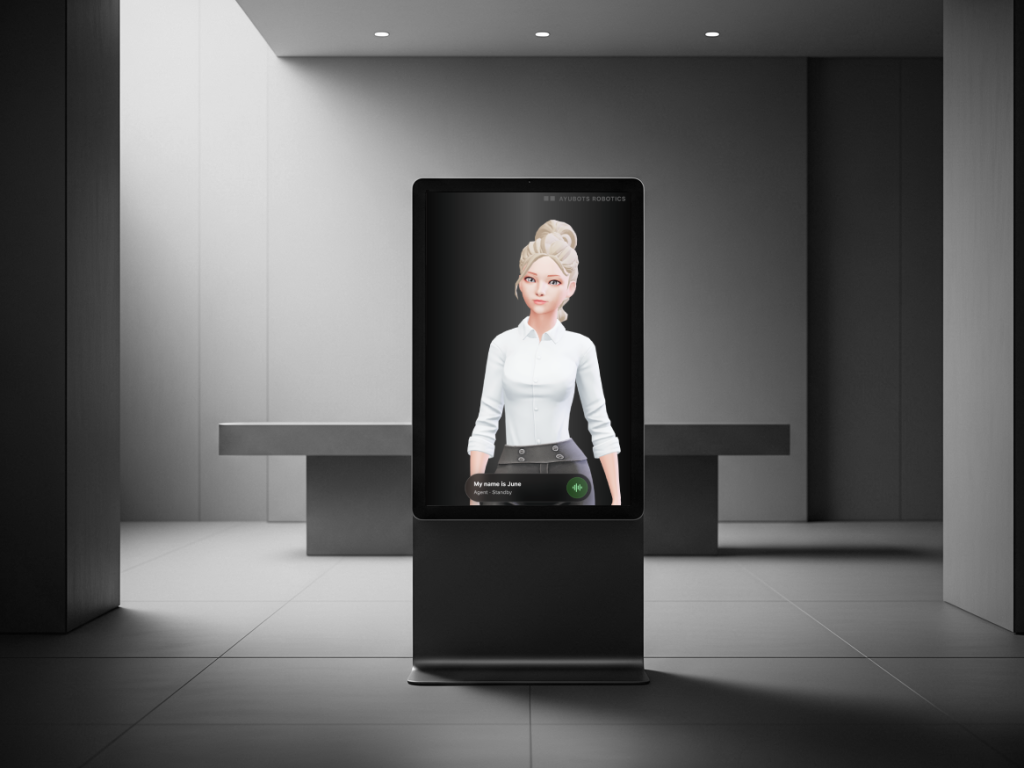
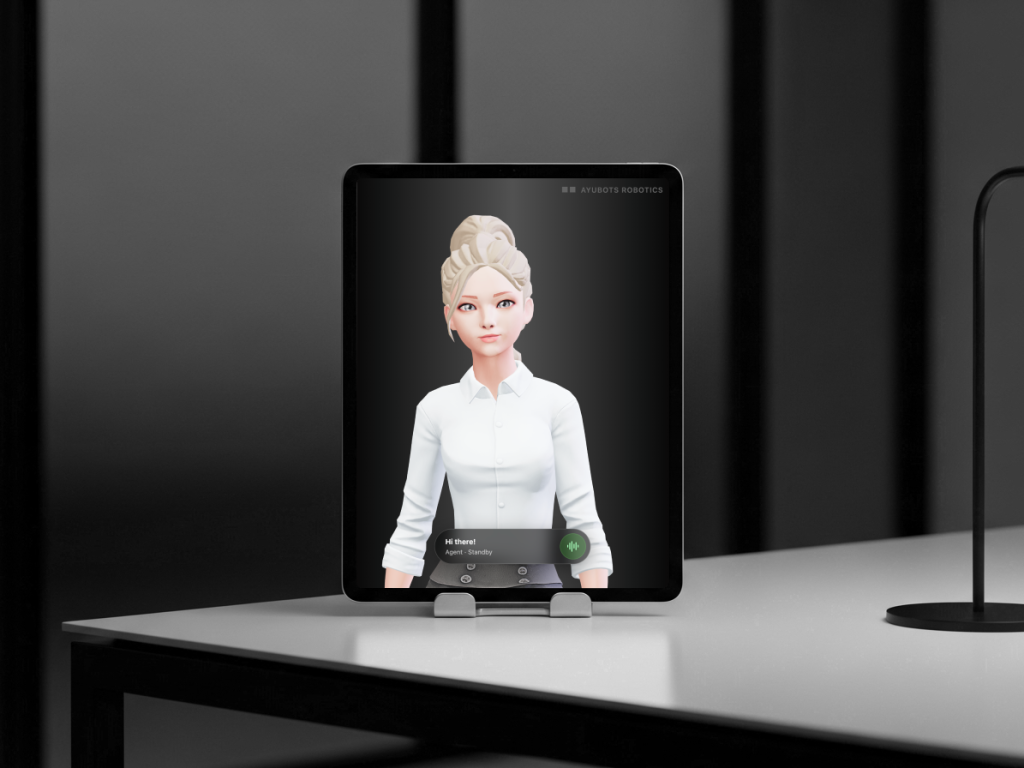
When you use Spatial Agents, you’re not getting a text bubble. You get a fully animated, lifelike 3D avatar. These agents have real personalities (based on real people!), use natural gestures, and make eye contact to create a genuinely engaging experience. It feels like talking to a friendly, helpful person.
An Expert That Learns Your Business
Here’s the best part: you don’t need to be a programmer to train it. Spatial Agents features a unique self-learning system. You activate your agent, and it starts asking you questions about your business, products, and processes. It trains itself by having a conversation with you, building its expertise just like a new employee.
Speak Everyone’s Language
Need to serve a diverse customer base? Spatial Agents speaks and understands 8+ languages out of the box, including English, Spanish, French, German, Japanese, Arabic, Hindi, and more. Your AI agent can instantly switch languages to help any customer feel welcome and understood.
Go Beyond Conversation with Agent Apps
Spatial Agents can get things done. They can be extended with “Agent Apps” to perform actions. Need to share your contact info? The agent will generate a QR code right on the screen. Need to show a product page? It will pull up the link. This “talk and do” capability is what makes it a truly functional assistant.
Runs on (Almost) Anything
You don’t need special, expensive hardware. Spatial Agents runs in a web browser, meaning it’s compatible with almost any modern device.
- Tablets/iPads: Perfect for personal, one-on-one interactions at a counter or help desk.
- Touchscreen Kiosks: Ideal for high-traffic public areas like lobbies and retail floors.
- Video Walls & Projections: Create a large-scale, high-impact “wow” factor for events or flagship stores.
Conclusion: Your Digital Displays Are Ready to Talk Back
AI digital signage is the next logical step in customer interaction. It closes the gap between the digital and physical worlds, transforming passive screens into proactive, helpful, and engaging conversational partners.
By leveraging the power of conversational AI, businesses can provide 24/7 expert support, break down language barriers, and create memorable experiences that drive sales and loyalty. This technology is no longer a futuristic dream; it’s a practical, affordable, and highly effective tool for today.
If you’re ready to stop broadcasting at your customers and start conversing with them, the technology is here. You can bring your displays to life today. Spatial Agents by Ayubots Robotics offers a free trial that lets you build and deploy your very first AI agent in minutes. Sign up and see for yourself how easy it is to make your signage smart.