
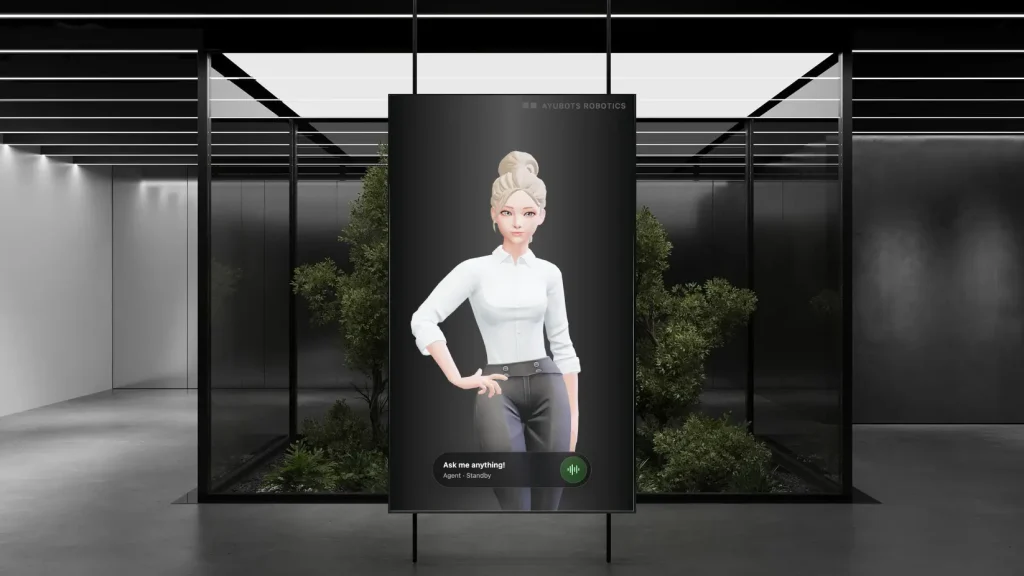
Imagine walking into a hotel lobby, a corporate office, or a large retail store. You have a question. Instead of searching for a sign, waiting in a long line, or flagging down a busy employee, you walk up to a sleek kiosk. A friendly, animated person on the screen turns, makes eye contact, and says, “Hi there! How can I help you today?”
You ask your question in plain English, Spanish, or Japanese. The agent understands you perfectly and not only gives you the answer but also displays a map on the screen and offers to send directions to your phone.
This isn’t science fiction. This is the core concept behind a new wave of powerful technology. This article is dedicated to defining Spatial Agents by Ayubots Robotics, a groundbreaking platform that places intelligent, conversational AI into physical environments. We’ll explore what they are, how they work, and why they’re set to revolutionize the in-person customer experience.
What Exactly is a “Spatial Agent”?
To put it simply, a Spatial Agent is an embodied, lifelike 3D AI agent designed specifically for customer service in physical spaces.
Think of it this way: for the last decade, AI has been trapped behind text boxes (chatbots) or in smart speakers (voice assistants). A Spatial Agent breaks free from these limitations. It’s an AI you can see, talk to, and interact with, much like you would a human employee. It’s “spatial” because it exists within your physical environment, and it’s an “agent” because it can autonomously understand, think, and act on your behalf.
This is not just a chatbot on a screen. The goal is to deliver authentic, human-like customer service at scale. It’s like hiring a robot, only more human.
More Than a Chatbot: The Power of Presence
The biggest difference you’ll notice is the presence. Spatial Agents are not just icons or text bubbles. They are fully animated 3D avatars with genuine, lifelike personalities.
These agents use natural gestures, facial expressions, and body language to convey emotion and build trust. When you speak, they turn to look at you, nod in understanding, and smile when appropriate. This “human-in-the-loop” design (even though it’s AI) is critical. It makes interactions feel more engaging and natural, avoiding the “uncanny valley” and making customers feel truly heard and welcomed.
The Core Technology: How Do Spatial Agents Think and Talk?
So, how does a digital person hold a real conversation? It’s a combination of several powerful technologies working in seamless harmony.
Advanced Conversational AI (NLP)
At the heart of every Spatial Agent is a powerful brain built on advanced Natural Language Processing (NLP) and Large Language Models (LLMs). This is what allows the agent to have natural, human-like conversations.
You don’t need to use specific keywords or awkward phrases. You can speak naturally, with all the “ums,” “ahs,” and complex sentences of a real conversation. The AI has deep understanding and clear speech recognition, allowing it to grasp the intent behind your words, not just the words themselves. It can answer follow-up questions, understand context, and respond like a friendly expert.
Breaking Down Barriers: Instant Multilingual Support
One of the most transformative features is the built-in multilingual capability. A single Spatial Agent can speak and understand 8+ languages instantly. This includes English, Spanish, French, German, Portuguese, Japanese, Arabic, Hindi, Russian, and more.
Imagine the value for a hotel in an international city, an airport, or a retail store in a diverse community. A customer from Germany can walk up and start speaking German, and the agent will reply fluently. The next customer can ask a question in Arabic, and the conversation continues without a hitch. This removes language barriers, makes all visitors feel welcome, and provides a level of service that’s nearly impossible to scale with human staff alone.
The “Self-Learning” Revolution: Training Your Agent
This is perhaps the most magical part. Traditionally, training an AI is a complex, data-heavy process. The Spatial Agents platform flips this on its head.
Spatial Agents “learn from you.”
Instead of you needing to be an AI engineer, the platform’s AI will simply ask you questions about your business, just like a new employee on their first day. You’ll have a conversation with your agent, telling it about your products, your store layout, your company processes, and common FAQs. The agent ingests this information and builds its expertise over time. This revolutionary, conversational training method means you can get an expert AI agent up and running in hours, not months.
Beyond Conversation: Taking Action in the Real World
A great employee doesn’t just answer questions; they help you get things done. Spatial Agents are no different. They are designed to be “agents of action,” not just sources of information.
Integrated Actions and “Agent Apps”
An agent’s abilities can go far beyond talk. They are integrated with the digital world and can perform tasks for the customer right on the spot.
For example, a Spatial Agent can:
- Generate QR Codes On-the-Fly: A customer asks for the Wi-Fi password, and the agent says, “Sure! Just scan this QR code on my screen.” They can share links to forms, product pages, or contact info.
- Pull Up Visuals: A shopper asks about a product, and the agent can bring up images, videos, or spec sheets on the screen.
- Provide Navigation: In a lobby or mall, an agent can display a map showing the customer exactly where to go.
This functionality can be extended even further with Agent Apps. These are add-on skills that let your agent perform business-specific tasks, like booking a meeting room, checking product inventory, or initiating a visitor check-in process.
Where Do You Deploy a Spatial Agent?
Because Spatial Agents are software, they are incredibly flexible. They are designed to be compatible with almost any modern device that has a web browser, a microphone, and a speaker. This allows you to choose the perfect “form factor” for your space.
Flexible Form Factors for Any Environment
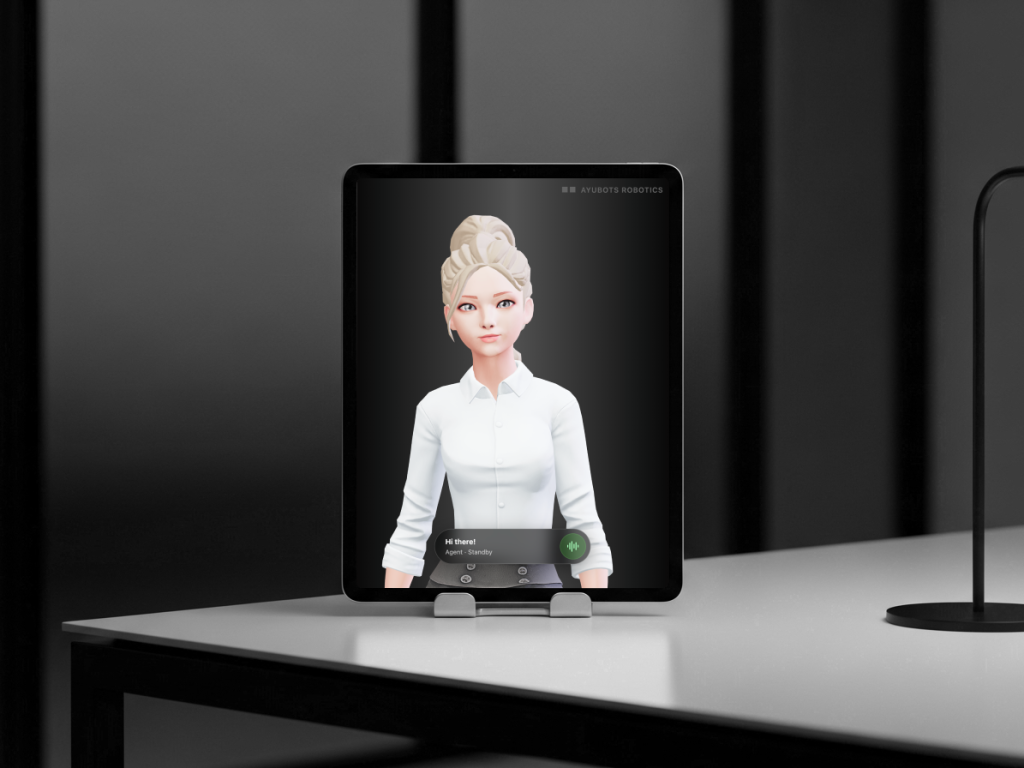
- Tablets & iPads: These are perfect for personal, one-on-one interactions. You can place them on a reception desk, a concierge counter, or mount them on a retail shelf as a dedicated product expert.
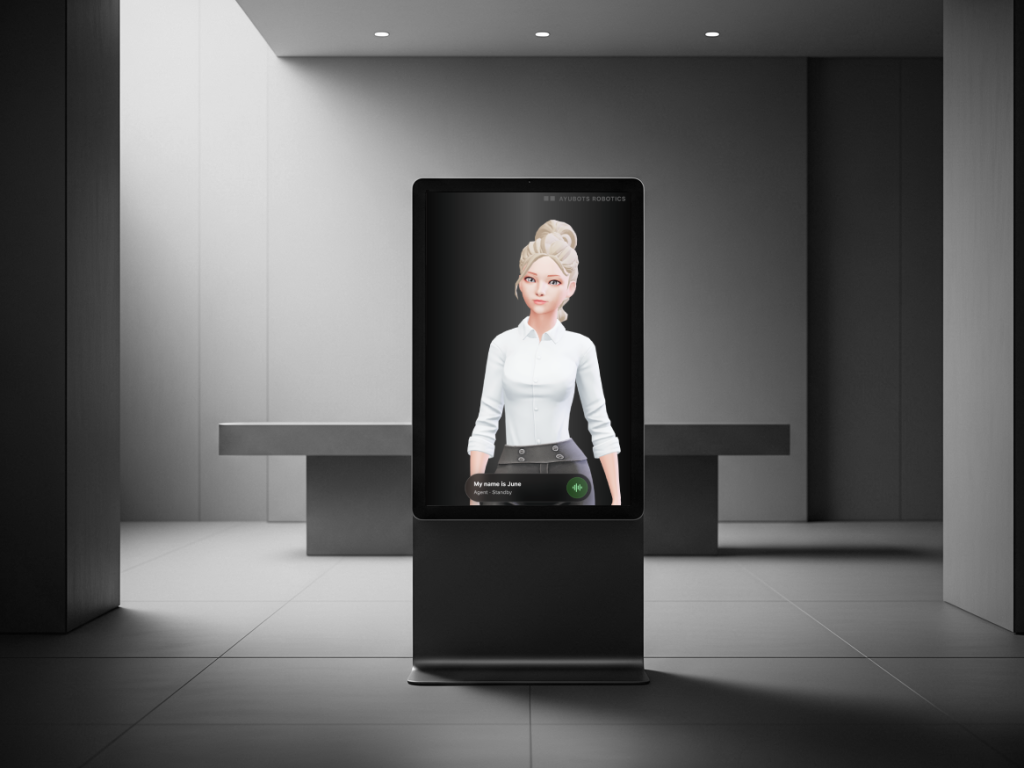
- Touchscreen Kiosks: This is the most common use case for high-traffic areas. A standalone kiosk is highly visible and invites interaction in lobbies, at event entrances, or as a central help desk.
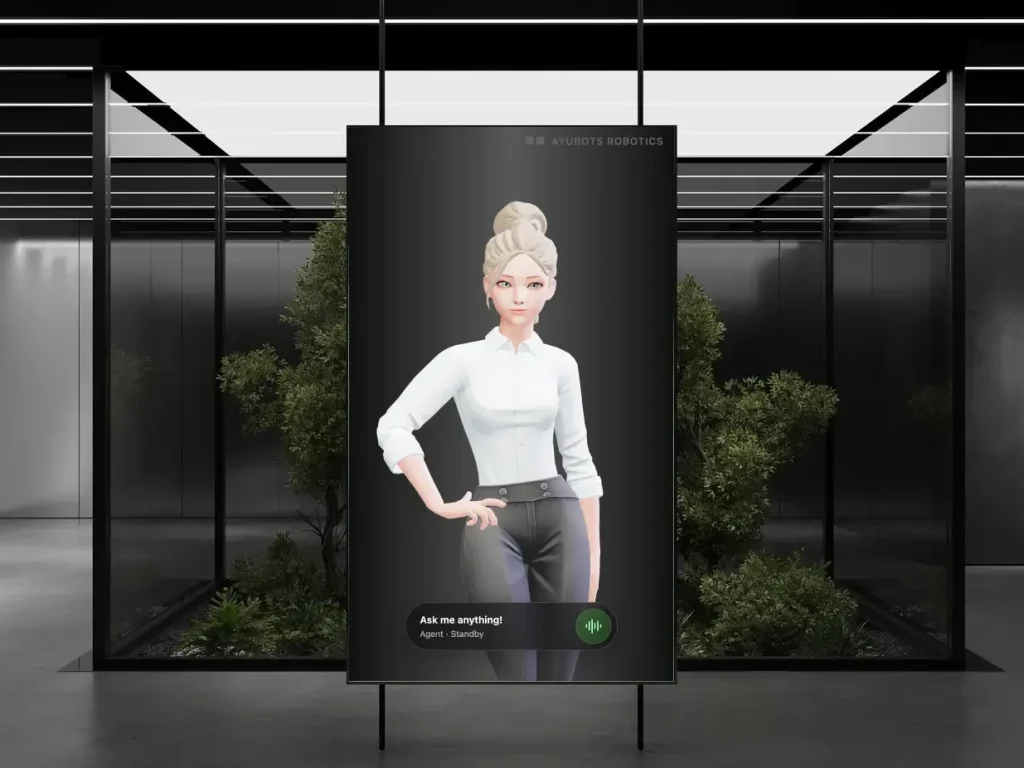
- Custom Setups: Here’s where it gets creative. You can run a Spatial Agent on a large interactive projection on a wall, a video wall, or any other large digital sign, turning a static display into an interactive brand ambassador.
Real-World Roles and Industries
The versatility of Spatial Agents means they can fit almost any industry. They are designed to fill real-world roles, automating repetitive inquiries and freeing up your human team for more complex, high-value tasks.
- Corporate: A 24/7 virtual receptionist to greet visitors, handle check-ins, and answer questions about the building.
- Hospitality: A multilingual concierge in a hotel lobby, offering restaurant recommendations, giving directions, and answering questions about amenities.
- Retail: A tireless product expert or store assistant, helping shoppers find items, compare products, and learn about current promotions.
- Healthcare: A friendly information guide in a hospital or clinic, helping with indoor navigation and answering non-sensitive FAQs.
- Events: An always-on help desk for trade shows and conferences, providing schedules, speaker information, and exhibitor locations.
The Spatial Agents Platform: The Definitive Solution
Defining Spatial Agents as a concept is one thing; building them is another. This is where the Spatial Agents (spatialagents.app) platform comes in. It is the B2B SaaS solution that brings all these capabilities together.
The platform provides everything you need in one place:
- The library of lifelike, animated 3D avatars.
- The advanced conversational AI brain.
- The unique self-training system that learns by asking you questions.
- The action integrations like QR code generation.
- The ability to add new skills via Agent Apps.
This isn’t just a tech demo; it’s a robust, scalable business solution. The platform is designed to provide a strong and immediate Return on Investment (ROI). By handling the most common and repetitive questions 24/7, Spatial Agents improve customer engagement and operational efficiency. You can provide “human-level” support around the clock, at a fraction of the cost of staffing.
With pricing that starts at roughly $60 per month per agent and enterprise plans for larger deployments, it’s an incredibly accessible way to upgrade your customer experience.
Conclusion: Your New Digital Employee is Ready
We’ve just finished defining Spatial Agents. They are far more than the next evolution of chatbots. They are the bridge between your digital brand and your physical space, offering a friendly, intelligent, and multilingual face for your business.
They represent a fundamental shift in customer service, one where AI becomes a helpful, present, and human-like collaborator. This technology is not a far-off future concept; it’s a practical, powerful, and affordable tool that businesses can use today to increase sales, provide better visitor experiences, and free their teams to focus on what matters most.
The best way to truly understand this new technology is to meet one.