
In today’s fast paced world, customers don’t just buy products; they buy experiences. They expect instant answers, personal recognition, and seamless help whenever and wherever they need it. This is where AI for CX, or artificial intelligence for customer experience, becomes a game changer. It’s no longer just about optimizing website chatbots. The new frontier is bringing that same level of smart, personalized assistance into our physical spaces: our hotel lobbies, retail stores, corporate offices, and event venues.
But how do you bridge the gap between a digital assistant and a real world visitor? You give your AI a physical presence. This is the power of a “spatial agent,” an AI designed to interact, understand, and assist in a physical environment. Forget the clunky, robotic interfaces of the past. We’re talking about lifelike, conversational, and genuinely helpful AI. Let’s explore the seven biggest wins you get when you deploy a spatial agent to revolutionize your customer experience.
What Is a Spatial Agent? (And Why It Matters for CX)
Before we dive into the wins, let’s clear up this new term. A “spatial agent” isn’t just another name for a chatbot. A chatbot lives in a text box on a website. A spatial agent is an AI with a presence.
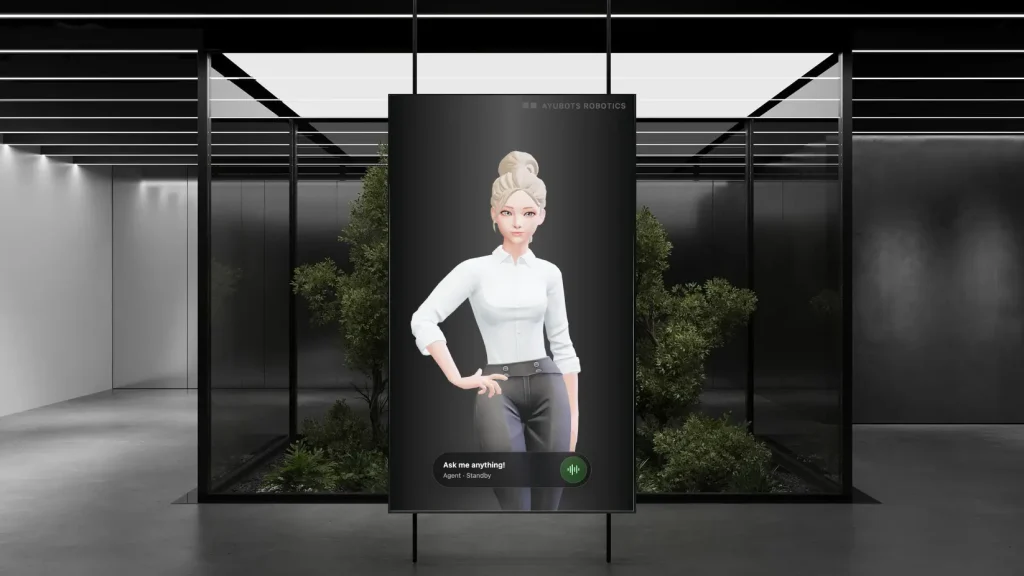
Think of it as an AI-powered digital employee. It’s designed to operate in a physical, or spatial, context, usually through a device like a touchscreen kiosk, a tablet at a front desk, or even large digital signage.
What truly sets them apart is their ability to interact in a human-like way. They don’t just offer a menu of buttons. They listen and speak using advanced natural language processing. The best-in-class spatial agents, like those powered by the Spatial Agents platform by Ayubots Robotics, go even further, featuring animated, lifelike 3D avatars. These avatars use natural gestures and facial expressions, making the interaction feel less like using a machine and more like talking to a friendly expert.
This matters for AI for CX because it solves the “last mile” problem. It brings the power of AI to your most valuable locations, greeting visitors, answering questions, and providing service with a personality that reflects your brand, 24/7.
The 7 Big Wins: How Spatial Agents Redefine Customer Experience
So, what happens when you add a spatial agent to your team? Your customer experience transforms in several key ways.
1. Delivering 24/7, Human-Like Service (Without the Burnout)
Your best employee can’t be at the front desk 24 hours a day, 7 days a week. Even when they are, they can get tired, stressed, or overwhelmed during a rush.
A spatial agent is always on, always friendly, and always patient. It provides a consistent level of high quality service, whether it’s 3 PM on a Tuesday or 3 AM on a Sunday. This is more than just automation. Because these agents have genuine personalities and expressive animations, they deliver this service with a warmth and presence that a simple screen or robot cannot. It’s the human touch, scaled.
2. Shattering the Language Barrier Instantly
Imagine a guest walking into your hotel lobby. They’ve just arrived from an international flight, they’re tired, and they don’t speak the local language. Immediately, they face a wall of friction.
A multilingual spatial agent shatters that wall. Top-tier platforms like Spatial Agents can speak and understand 8 or more languages instantly, including English, Spanish, French, German, Japanese, Arabic, and Hindi. The agent can detect the customer’s language and switch on the fly, providing a welcoming and effortless experience for a diverse global audience. This isn’t just a “nice to have” feature; it’s a profound statement of inclusivity and care.
3. Providing Deep, On-Demand Expertise
How long does it take to train a new employee on every product, process, and policy? What happens when a customer asks a complex question about a niche product?
A spatial agent becomes your resident expert on day one. And it only gets smarter. This is where the self-learning capabilities of platforms like Spatial Agents truly shine. You don’t need a team of developers to program it. The AI trains itself about your business by asking you questions, just like a new hire would. It builds deep expertise over time, ensuring that every customer gets the most accurate and helpful information, every single time.
4. Moving Beyond Talk to Take Action
A good customer experience isn’t just about answering questions; it’s about solving problems. A spatial agent that only talks is just a glorified FAQ. A great spatial agent gets things done.
This is a core win for AI for CX. Modern spatial agents can perform integrated actions. For example, a customer can ask for directions, and the Spatial Agents platform can generate a QR code right on the screen. The customer scans it and instantly gets a map or contact form sent to their phone. These agents can pull up website links, show product videos, or be extended with “Agent Apps” to add new skills, like booking a meeting room or checking inventory.
5. Creating Consistent, Scalable Brand Interactions
Your brand’s voice is one of your most important assets. But ensuring that voice is consistent across every location and every employee is a massive challenge.
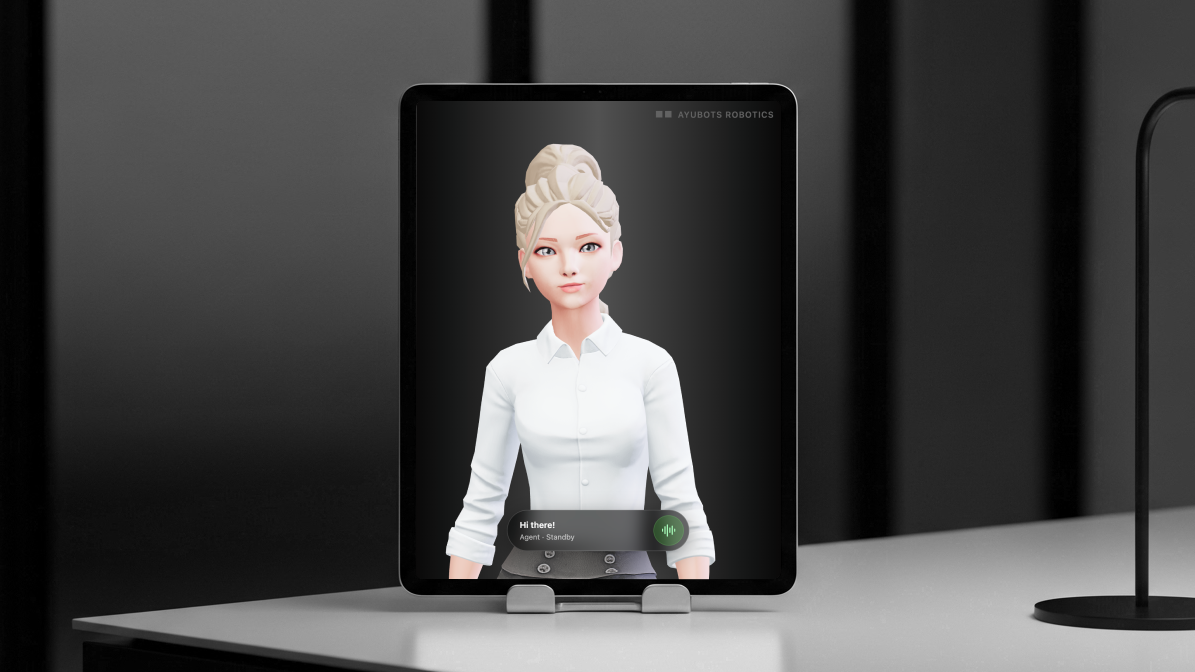
A spatial agent is your perfect brand ambassador. You can deploy the exact same friendly, knowledgeable, and on-brand agent personality across all your locations. Whether a customer interacts with your agent on a small tablet in a retail store, a large kiosk in a corporate lobby, or digital signage at a trade show, they get the same high-quality experience. This consistency builds trust and reinforces your brand identity at scale.
6. Boosting Engagement with Lifelike Presence
Let’s be honest: most digital kiosks are boring. They are static, impersonal, and people often walk right past them. They are a utility, not an experience.
Lifelike spatial agents are the opposite. They are engaging. The Spatial Agents platform, for instance, uses 3D avatars based on real people. They make eye contact, use natural hand gestures, and have subtle, realistic animations. This “lifelike presence” is magnetic. It invites interaction. Customers are more likely to approach and ask questions, turning a passive environment into an active, helpful, and memorable touchpoint.
7. Capturing Actionable Insights to Improve CX
Do you know what your customers really ask about when you’re not around? What are the most common points of confusion in your store or lobby?
Every question asked of your spatial agent is a piece of data. This feedback loop is an AI for CX goldmine. By seeing the most common inquiries, you can identify gaps in your signage, misunderstandings about your products, or areas where your physical space is causing friction. These insights are not guesses; they are direct, aggregated data from your customers, allowing you to make smart, informed decisions to improve the overall experience.
Spatial Agents: Your AI for CX Platform
Reading this list, you might be thinking, “This sounds great, but building it must be incredibly complex.” In the past, it was. You would need 3D modelers, AI researchers, NLP experts, and hardware specialists.
This is the exact problem the Spatial Agents platform was built to solve. It’s a B2B SaaS solution that lets you create and deploy your own lifelike, AI-powered spatial agents without writing a single line of code.
It packages all seven of these “wins” into one easy-to-use platform:
- Lifelike Avatars: Choose from a library of friendly, animated 3D agents with real personalities.
- Natural Conversation: It speaks and understands 8+ languages with deep, human-like comprehension.
- Self-Learning: It learns about your business simply by having a conversation with you.
- Actionable: It can generate QR codes, open links, and be extended with custom Agent Apps.
- Device Flexible: It runs on almost any modern device with a web browser, from an iPad to a touchscreen kiosk or a video wall.
This makes it the perfect fit for countless roles: a virtual receptionist in a corporate office, a multilingual product expert in retail, a 24/7 help desk in a hospital, or an engaging information guide at an event. It delivers authentic, human-level support at scale, improving efficiency and customer engagement with a clear return on investment.
Conclusion: The Future of Customer Experience is Here
AI for CX is rapidly moving beyond the webpage and into the physical world. The goal is to provide helpful, human-like interactions wherever your customers are. Spatial agents are the key to unlocking this, turning passive spaces into engaging, supportive, and intelligent environments.
By delivering 24/7 multilingual service, deep expertise, and genuine, actionable help, they don’t just solve customer problems; they create positive, memorable experiences.
The best part? This technology is no longer futuristic. The best way to understand the impact of a spatial agent is to see one in action. Spatial Agents is available now, and you can start building your first AI agent today.