
Take a look around any modern city, retail store, or corporate lobby. The days of static, printed posters are long gone, replaced by vibrant digital screens. But even those screens are evolving. We’re moving beyond simple video loops and into a new era of truly interactive, intelligent displays. Welcome to the world of AI digital signage, the next massive leap in how businesses communicate, assist, and engage with people in the real world.
By 2026, the screens you see won’t just show you information; they’ll talk to you, understand you, and react to you. This isn’t science fiction. It’s the convergence of artificial intelligence, natural language processing, and advanced display technology. For businesses, this opens up a powerful new channel for customer service, marketing, and operations. Let’s explore the trends shaping this exciting future and how you can be a part of it.
What Exactly is AI Digital Signage?
At its simplest, AI digital signage is an interactive display system that uses artificial intelligence to deliver dynamic, personalized, and conversational experiences.
Think of traditional digital signage as a one-way street. It pushes content (ads, directories, menus) at an audience. You can look at it, but you can’t interact with it in a meaningful way.
AI digital signage turns this into a two-way conversation.
It uses a stack of powerful technologies:
- Conversational AI: This allows the display to understand spoken language (Natural Language Processing or NLP) and respond intelligently, just like a human would.
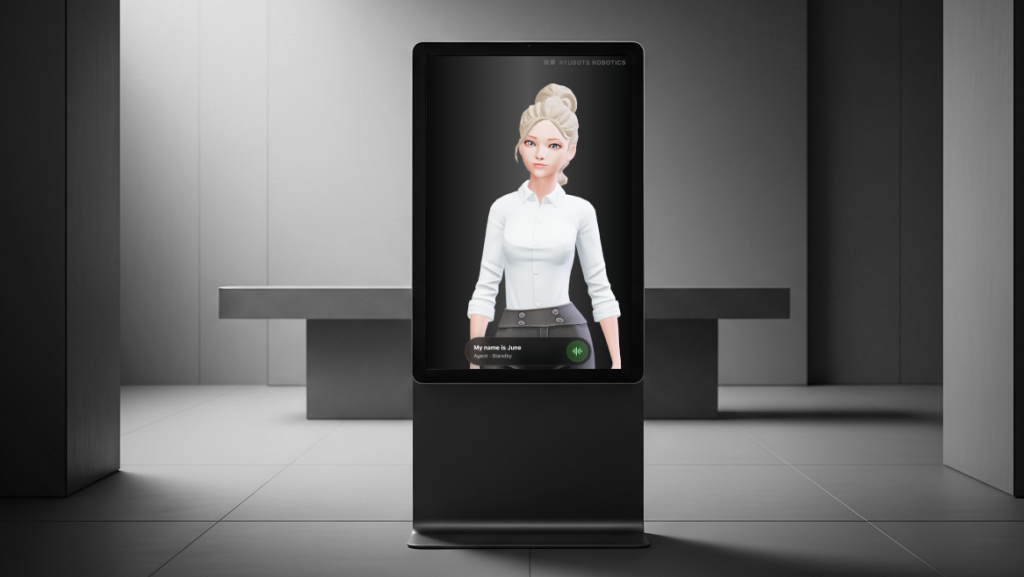
- Lifelike Avatars: Instead of a text-based chatbot, AI digital signage often features animated 3D avatars that can gesture, show expression, and create a genuine, human-like connection.
- Computer Vision: Some systems can use cameras (while respecting privacy) to anonymously analyze audience demographics, foot traffic, or even mood, allowing the content to adapt in real-time.
- Machine Learning: The “brain” behind the operation, machine learning allows the system to learn from every interaction, becoming smarter and more helpful over time.
Instead of a passive screen, you now have a virtual assistant, a brand ambassador, or an expert guide, ready to help 24/7.
Why AI is the Future of Public Displays
The shift to AI digital signage isn’t just a gimmick; it’s driven by clear business benefits. Traditional signage struggles with “banner blindness,” where people are so inundated with ads that they simply stop seeing them. AI-powered displays break through that noise by offering genuine value.
1. Unprecedented Engagement:
Nothing grabs attention like being spoken to. When a lifelike avatar on a screen makes eye contact and offers help, it stops people in their tracks. This active engagement is far more memorable and effective than any passive video loop.
2. Radical Personalization:
AI allows a single screen to become a thousand different experiences. It can detect that a customer is looking confused and proactively offer wayfinding. It can recognize a group and feature a family-friendly promotion. This level of relevance was impossible until now.
3. 24/7 Expert Assistance:
Imagine having your best employee at every entrance, kiosk, and high-traffic area, all at once. An AI agent can answer complex product questions, provide directions, or act as a virtual receptionist, freeing up human staff for more complex tasks.
4. Rich, Actionable Data:
AI signage doesn’t just display content; it gathers insights. You can learn what questions customers ask most, which products are most engaging, and where people get lost. This data is a goldmine for improving operations, marketing, and the overall customer experience.
Key AI Digital Signage Trends to Watch by 2026
The technology is here. Now, let’s look at the specific trends that will define the AI digital signage landscape over the next few years.
Trend 1: Hyper-Personalization and Predictive Content
This is where AI’s analytical power shines. Future signage won’t just react; it will predict. By analyzing real-time data like time of day, weather, or even anonymous crowd flow, the system will automatically surface the most relevant content.
Imagine a digital menu board at a cafe. At 8 AM on a cold day, it proactively highlights hot coffee and breakfast specials. At 3 PM on a sunny afternoon, it switches to iced drinks and snacks. This is basic. Now, add AI. The system knows from past data that on Fridays, people are 30% more likely to buy a pastry. It will feature those pastries more prominently before you even ask.
Trend 2: Interactive, Conversational Agents
This is the biggest trend of all. The screen is transforming from a television into a colleague. By 2026, we will expect to talk to our displays.
This trend is moving beyond simple touchscreens (which are a hygiene concern for many) and into voice-first interaction. You’ll walk up to a display in a mall, hospital, or airport and simply ask:
- “Where is the nearest restroom?”
- “What are the side effects of this medication?”
- “Which laptop here is best for video editing under $1000?”
And a friendly, expert agent will answer you in plain, natural language. This turns a passive display into an active, problem-solving tool.
Trend 3: Real-Time Analytics and Audience Measurement
The next generation of AI digital signage will be deeply integrated with analytics. Using privacy-compliant computer vision, systems will be able to measure:
- Dwell Time: How long did people stop and look at the display?
- Engagement Rate: What percentage of passersby actually interacted with the agent?
- Emotional Sentiment: Did the content or interaction make the person smile or look confused? (Anonymously, of course).
- Demographic Analysis: What is the general age range and gender split of your audience at different times?
This closed feedback loop allows businesses to A/B test content, optimize agent personalities, and prove the ROI of their signage investment.
Trend 4: Automated Content Creation and Curation
Keeping signage content fresh is a major challenge. AI is set to solve this. Generative AI models will be able to create and curate content on the fly.
For example, a retail display could pull from a live product feed, recent customer reviews, and current marketing goals to generate a brand new, engaging promotional video automatically. A corporate lobby display could summarize top company news, feature an “employee of the week,” and display a welcome message for a visiting client, all without a designer touching a file.
Trend 5: Seamless Integration with IoT and Mobile
AI signage won’t exist in a vacuum. It will be a key hub in a larger “smart building” or “smart retail” ecosystem.
- IoT (Internet of Things): An AI kiosk could connect to smart shelves. A customer asks, “Do you have this shoe in a size 10?” The AI agent checks the shelf’s real-time inventory and replies, “Yes, we have two pairs in stock in aisle 7.”
- Mobile Hand-off: The interaction can start on the screen and end on your phone. The AI agent can say, “I’ve found the directions for you. Would you like me to send them to your phone?” You scan a QR code, and the map instantly appears in your preferred app.
Real-World Applications: Where You’ll See AI Signage
This technology is incredibly versatile. Here are just a few of the roles these AI agents will play:
- Retail: As product experts that answer detailed questions, compare items, and upsell accessories.
- Hospitality: As virtual concierges in hotel lobbies that book restaurant reservations, recommend local attractions, and handle check-in.
- Corporate: As AI receptionists that greet visitors, notify employees of their guest’s arrival, and answer common HR questions.
- Healthcare: As patient guides in hospitals that provide wayfinding, explain procedures, and manage appointments.
- Events & Tradeshows: As multilingual hosts that provide schedules, speaker information, and capture sales leads.
Spatial Agents: Bringing Your AI Digital Signage to Life
This future of conversational, interactive displays isn’t just a forecast. It’s already here, and it’s being powered by platforms like Spatial Agents.
Spatial Agents by Ayubots Robotics is a platform designed specifically to transform any screen into an intelligent, AI-driven customer service point. It’s the “brain” that powers the conversational agent trend, making it accessible to any business.
Instead of just imagining these trends, Spatial Agents lets you build them. Here’s how it directly addresses the future of AI digital signage:
It’s Built on Lifelike, Conversational AI
The core of Spatial Agents is its lifelike, animated 3D avatars. These aren’t clunky robots or text boxes. They are friendly, expressive agents with real personalities that make interactions feel genuine. They are designed to have natural, human-like conversations, with deep understanding that allows them to respond like a friendly expert, not a “bot.”
It’s Instantly Multilingual
A key challenge for signage in public spaces is catering to a diverse audience. Spatial Agents speaks and understands 8+ languages (like English, Spanish, French, German, Japanese, and more) right out of the box. An international visitor can walk up and start speaking their native language, and the agent will understand and reply instantly.
It Learns Like a Real Employee
You don’t need a team of developers to program it. Spatial Agents features a unique self-learning system. You “train” it about your business (products, processes, locations) by simply talking to it or providing documents. It builds expertise over time, just like a new hire, and can be updated with new information in seconds.
It Does More Than Just Talk
An AI agent should be able to do things. Spatial Agents can perform integrated actions. For example, an agent can:
- Generate a QR code on-the-fly to share a link, a map, or a contact form.
- Pull up web pages or product videos on the screen.
- Integrate with “Agent Apps” to add new skills, like booking an appointment or connecting to your inventory system.
It Runs on Any Device
This is crucial for digital signage. Spatial Agents runs on almost any modern device with a web browser. This means you can deploy your AI agent on:
- Tablets/iPads for counter-top or mobile use.
- Touchscreen Kiosks for high-traffic public areas.
- Custom Hardware like interactive projections or large video walls.
It even allows for an “Ads & Assistance” model, where your traditional banner ads can run on one side of the screen while the Spatial Agent is on the other, ready to help. It transforms passive screens into living, helpful brand experiences.
Getting Started: What to Consider
Embracing AI digital signage might seem daunting, but platforms like Spatial Agents are designed to make it simple.
- Define Your Goal: What problem will your AI agent solve? Is it a wayfinding guide? A product expert? A receptionist? A clear goal will guide its training.
- Choose Your Hardware: You may already have the hardware you need. Any modern kiosk, tablet, or large screen with a web browser can work.
- Train Your Agent: This is the fun part. You don’t code; you teach. You provide it with your website info, FAQs, product lists, and building maps.
- Deploy and Learn: Put your agent in a public space and watch it work. The insights you’ll gather in the first week alone will be invaluable.
The Future is Interactive: Are You Ready?
By 2026, AI digital signage will be the standard. The expectation from customers will be that displays are not just for watching, but for interacting. They will expect screens to be helpful, intelligent, and conversational.
This shift presents a massive opportunity for businesses to build deeper customer relationships, improve efficiency, and stand out from the competition. The future of customer service is in physical spaces, and it’s powered by AI.
If you’re ready to stop just displaying content and start engaging customers, the technology is ready for you. You can start building your first AI digital signage agent today by signing up for a free account on Spatial Agents.