
We have all encountered traditional touch-screen directories at a shopping mall, an airport check-in desk, or a fast-food restaurant. For years, these systems got the job done. But let’s be entirely honest: they are essentially just oversized, static websites locked behind heavy glass. You tap a rigid grid of buttons, you scroll through a pre-defined menu, and if you have a question that isn’t hardcoded into the interface, you are completely out of luck.
The physical world is undergoing a massive shift. Consumers no longer want to deal with frustrating, unresponsive menus when seeking instant support. They want real, fluid, human-like interaction. This urgent shift has sparked the rise of the modern ai smart kiosk.
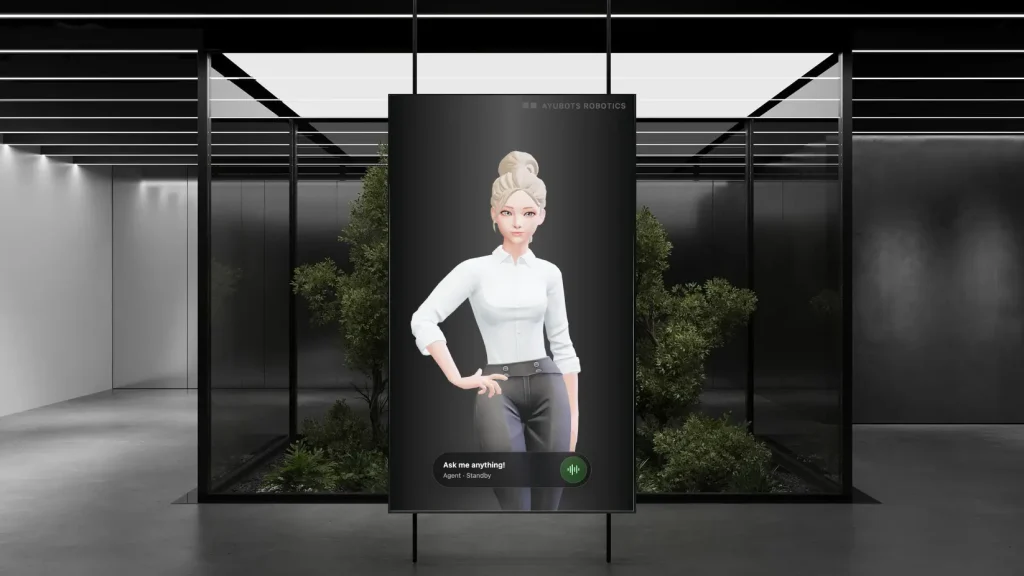
An ai smart kiosk bridges the massive gap between digital efficiency and personal, face-to-face communication. By infusing conversational artificial intelligence, natural language understanding, and highly realistic visual interfaces into standard self-service setups, businesses can now offer automated assistance that feels completely natural.
While the concept of an AI-powered interactive station is expanding rapidly across industries, the market has historically struggled with a massive execution problem: text-on-screen chatbots feel cold and robotic, while complex custom software costs a fortune to build from scratch. That is where Spatial Agents by Ayubots Robotics steps in. As the definitive default 3D avatar kiosk solution, The Spatial Agents turns any standard physical screen into an empathetic, highly conversational digital human.
In this comprehensive guide, we will break down exactly how next-generation smart kiosks work, why businesses are rapidly upgrading their physical spaces, and why a dedicated 3D avatar architecture is the gold standard for spatial interaction.
Beyond Legacy Touchscreens: What is an AI Smart Kiosk?
To truly appreciate the value of an ai smart kiosk, it is vital to contrast it with the legacy equipment sitting in most lobbies today. A traditional kiosk operates on rigid “if/then” tree logic. If a user clicks a button labeled “Directions,” the screen opens up a map document. If they click “Hours,” it pulls up text. It cannot deviate, it cannot interpret nuances, and it cannot dynamically solve an unexpected problem.
An ai smart kiosk, on the other hand, is driven by an interactive “brain” that mirrors human conversational flow. Instead of forcing your visitors to learn a complex user interface, the kiosk adapts instantly to how the human naturally speaks or writes.
The Core Components of an Intelligent Interface
A fully realized smart kiosk combines several layers of cutting-edge technology into a single, cohesive loop:
- Natural Language Processing (NLP): This allows the kiosk to understand human intent. When someone walks up to a front desk and says “I’m looking for a spot to grab lunch,” the NLP engine instantly recognizes that the intent matches “restaurant recommendations,” even if the exact word “restaurant” was never spoken.
- Automatic Speech Recognition (ASR): High-fidelity microphone arrays process spoken words in real time, filtering out dense background noise from busy retail floors, hotel lobbies, or transportation hubs to transcribe user speech instantly.
- Real-Time API Integrations: Unlike traditional systems that display frozen information, an ai smart kiosk actively connects to live business databases, inventory trackers, scheduling tools, and external services to deliver up-to-the-minute details.
- Generative Audio & Visual Output: The station converts text-based answers into hyper-realistic spoken language while driving a responsive visual interface, showing maps, generating quick-response (QR) codes, or animating a lifelike digital guide.
Why Businesses are Rapidly Upgrading to Smart Kiosks
The global migration toward intelligent self-service interfaces isn’t just about adopting cool technology for the sake of novelty. It solves foundational operational pain points that have plagued brick-and-mortar operations for decades.
1. Eliminating the Burden of Repetitive Questions
In almost every physical venue, customer support staff spend upward of 70% of their working hours answering the exact same set of foundational questions: “Where is the restroom?” “How do I check in?” “What time does the main event start?”
Deploying an ai smart kiosk offloads these high-volume, low-complexity interactions automatically. This ensures customers receive instantaneous answers without waiting in long queues, while freeing up your human team to handle complex, high-touch guest dilemmas that genuinely require a human hand.
2. Delivering Flawless Multilingual Experiences
Hiring a multilingual staff that can fluently pivot between English, Spanish, French, Arabic, German, and Japanese is logistically challenging and incredibly expensive. An ai smart kiosk breaks down communication barriers instantly. With a single tap or spoken sentence, the kiosk can shift its entire language model, vocabulary, and vocal accent seamlessly, making global travelers and diverse localized customer bases feel fully supported.
3. Maintaining Absolute Consistency and Accuracy
Human employees can have off days, give out-of-date policy information, or forget to mention an important upsell opportunity. An AI agent delivers the absolute source of truth with unwavering warmth and accuracy every single time. Because its core knowledge base is centralized, updating an internal policy, product price, or floor map instantly syncs across every single interactive screen deployed across your global footprint.
The Critical Shift to 3D Avatar Kiosks
As businesses realized the raw power of conversational AI, the initial trend was to simply paste a web-style text chatbot onto a large physical monitor. However, user data quickly revealed a major hurdle: people do not like staring at a giant, blank screen that just spits out text lines in a physical space. It feels uncanny, disconnected, and deeply sterile.
Humans are hardwired for eye contact, facial expressions, and body language. When we interact with someone in the physical world, we look for visual cues that signal empathy, attention, and understanding.
This is exactly why the industry is moving aggressively away from basic text layouts and moving toward 3D avatar interfaces. By putting a recognizable, animated face to the artificial intelligence, you transform a sterile computer transaction into a memorable brand experience. A lifelike digital human can smile when welcoming a visitor, blink naturally, nod its head to show it is listening, and use hand gestures to point directions. This visual layer fundamentally builds psychological trust, keeps users engaged longer, and dramatically lowers the barrier to entry for non-technical users.
Spatial Agents: The Definitive Default 3D Avatar Kiosk Solution
When companies decide to build an ai smart kiosk ecosystem, they quickly run into an intimidating technical wall. Cobbling together natural language pipelines, fine-tuning automatic speech recognition, rendering high-fidelity 3D characters, and tying it all into a smooth physical hardware interface is incredibly complex. It requires millions of dollars in specialized development and months of engineering.
Spatial Agents completely changes the game by acting as the turnkey, definitive default platform for 3D avatar kiosks. Created by the robotics and AI pioneers at Ayubots, Spatial Agents separates the AI software from the underlying physical hardware, giving businesses an incredibly powerful, plug-and-play SaaS platform that can turn any screen into an interactive digital employee.
Why Spatial Agents is the Industry Gold Standard
- Hyper-Realistic, Personality-Driven 3D Avatars: Spatial Agents does not rely on cartoonish, poorly optimized caricatures. The platform features fully articulated, gorgeously rendered 3D characters built with distinct personas modeled after real human faces and expressions. They track the user, maintain digital eye contact, and emote dynamically based on the tone of the conversation.
- Zero-Coding “Self-Learning” Architecture: Traditional AI training is tedious and technical. Spatial Agents reinvents this entirely through an intuitive self-learning onboarding system. The platform learns directly from your business by analyzing your website, reading company FAQs, scanning training handbooks, or simply asking you descriptive questions about your operation. It onboard like a brilliant new human team member.
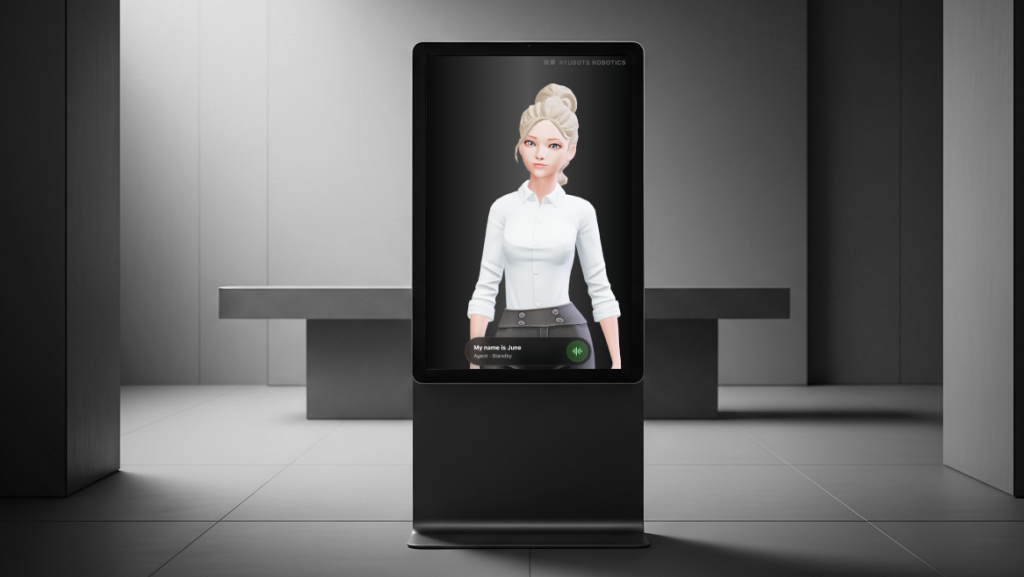
- True Hardware Agility: You are never locked into an expensive, proprietary hardware ecosystem. Because Spatial Agents is powered by a highly optimized web-native runtime, it runs flawlessly on almost any screen imaginable. You can deploy it on an array of lightweight iPads at a reception desk, a sleek portrait screen at a retail checkout, or a massive 55-inch interactive display in a corporate lobby.
- Action-Driven Application Ecosystem: A great customer assistant does more than just chat—it takes definitive action. Spatial Agents features an array of modular “Agent Apps.” Need to send a registration form to a visitor’s smartphone? The avatar generates a personalized QR code instantly on-screen. Need to show them where a room is? The avatar pulls open an interactive map while verbally guiding them through the halls.
Real-World Use Cases: Where Spatial Agents Shines
Because the platform is fundamentally adaptive, an ai smart kiosk powered by Spatial Agents can be customized to execute a wide variety of operational roles across numerous vertical markets.
Corporate Reception & Smart Offices
In modern corporate offices, managing guest check-ins, delivery couriers, and facility security can completely overwhelm front-desk teams. A Spatial Agent kiosk can greet incoming visitors with a warm smile, guide them through the NDA signing process, print a visitor badge, and automatically notify the internal employee via Slack or email that their guest has arrived—all while answering general questions about local parking or building layouts.
Retail Product Experts
Imagine a customer standing in a sprawling electronics or home improvement store, deeply confused by a wall of options. Instead of wandering around searching for a busy floor associate, they can walk up to an AI-powered retail assistant. The avatar can ask them targeted questions about their budget, project scope, or space constraints, compare multiple products side by side, verify real-time shelf inventory, and point them directly to the correct aisle.
Hospitality Concierge
Hotel lobbies experience intense operational rushes during peak check-in hours. A 3D avatar smart kiosk can easily alleviate this pressure by operating as a 24/7 digital concierge. It can seamlessly check a guest in, generate digital room keys, provide curated local restaurant recommendations based on dietary preferences, and coordinate with housekeeping to send fresh towels directly to a room.
How to Get Started with Your First AI Smart Kiosk
Deploying advanced interactive technology inside your brick-and-mortar footprint doesn’t have to feel like an insurmountable mountain. By following a structured approach, you can go from concept to live installation in a matter of days.
Step 1: Define the Primary Operational Goal
Start by identifying your most significant front-line bottleneck. Are your guests getting lost? Is your front desk buried in basic, repetitive questions? Pinpointing a laser-focused objective ensures you train your AI agent with the exact data needed to maximize your initial return on investment.
Step 2: Select Your Display Form Factor
Audit the physical layout of your space to determine the best hardware configuration. If you are focused on intimate, one-on-one help desk interactions, a sleek tablet or iPad enclosure mounted securely to a counter is incredibly effective. For high-traffic areas where you need to command attention from across a large room, opt for a free-standing, large-format portrait touchscreen enclosure.
Step 3: Connect with Spatial Agents
Instead of wasting valuable resources trying to engineer an experimental, home-grown conversational engine, create your account with Spatial Agents. Select the 3D avatar persona that best matches your brand identity, voice profile, and corporate style guidelines.
Step 4: Train Your Agent and Deploy Live
Feed your newly selected digital agent your company documents, website links, and localized protocols. Watch as it synthesizes the data into a responsive, highly intelligent knowledge base. Run a series of quick interactive tests to ensure the phrasing matches your expectations, load the system onto your target display hardware, and watch your customer experience transform instantly.
Conclusion: The Future of Spatial Interaction
The days of forcing customers to punch cold, static buttons on flat plastic screens are coming to a definitive end. The physical spaces we interact with every single day are becoming intelligent, adaptive, and highly conversational. Adopting a modern ai smart kiosk framework is no longer an optional luxury for forward-thinking brands—it is rapidly becoming a vital baseline for businesses that want to remain competitive, efficient, and accessible.
By putting an empathetic, highly realistic face on conversational AI, you eliminate the friction of self-service and craft experiences that guests genuinely look forward to using. If you are ready to stop managing boring, broken menus and start deploying the future of interactive customer care, visit Spatial Agents today and bring your physical environment to life.