
When you hear the phrase “digital signage,” what comes to mind? For many, it’s a TV screen in a lobby looping a welcome video. Or maybe it’s a digital menu board at a fast-food restaurant. For decades, digital signage software was just that: a tool to schedule and play media on a loop. It was a one-way street. A digital poster.
But the game has completely changed. Today, customers, visitors, and employees expect more. We live in an interactive world where we can ask our phones for directions, get instant answers from the web, and expect personalized experiences. A looping video just doesn’t cut it anymore. It’s just noise.
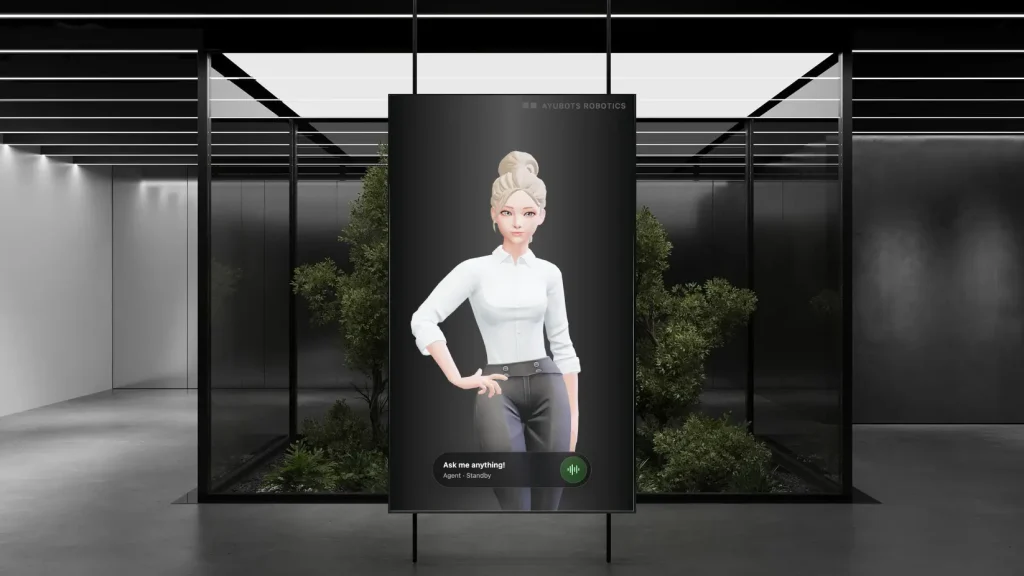
The concept of “advanced” digital signage software no longer means a better playlist scheduler or sharper 8K resolution. True advancement isn’t about the pixels; it’s about the intelligence. The most advanced software today is about turning a passive screen into an active, intelligent, and conversational partner. We’re talking about platforms that can see, listen, understand, and engage in a human-like way.
This is the new frontier, and it’s powered by conversational AI and lifelike virtual agents. It’s software that doesn’t just show you information but talks to you about it.
What Do We Mean By “Advanced” Digital Signage?
To understand where we are, we have to appreciate where we’ve been. The evolution of digital signage has been a journey from static to truly smart.
Beyond the Slideshow: The Limits of Traditional Software
Traditional digital signage platforms were a huge leap from paper posters, but they have a clear ceiling. Their primary function is to display.
- One-Way Communication: They talk at you, not with you. There is no feedback loop.
- Static Content: The content is pre-made and scheduled. Updating it across hundreds of screens can be a slow, manual process.
- Language Barriers: A sign in a hotel lobby is typically in one language. What about visitors from Japan, Germany, or Brazil?
- Zero Personalization: The sign shows the same ad or message to a CEO, a delivery driver, and a visiting client. It’s impersonal and inefficient.
This old model is being replaced by something that feels more like science fiction, but it’s very real.
The New Standard: Interactive and Intelligent
The “most advanced” digital signage software is a platform built on a foundation of artificial intelligence. It’s software that turns a screen into a problem-solver.
Here’s what the new standard includes:
- Two-Way Conversation: You can walk up to a screen and ask it a question. In your own words. “Where is the nearest coffee shop?” “What are the specs on this new laptop?” “I’m here to see June.”
- Real-Time Understanding: The software uses Natural Language Processing (NLP) to understand the intent behind your words, not just keywords.
- Human-Like Interaction: Instead of a text-based chatbot, this software provides a friendly, animated 3D avatar. This “face” of the AI makes the interaction feel natural, engaging, and trustworthy.
- Instant Multilingual Support: The agent can understand a question in Spanish and be asked the next question in French, translating and responding instantly.
- Self-Learning: The AI gets smarter over time. It learns your products, your building layout, and your company’s processes, just like a new employee.
The Core Tech Driving the Next Generation of Signage
This transformation isn’t magic. It’s a stack of powerful technologies working in harmony. The most advanced digital signage software is really an integration of several AI disciplines.
Artificial Intelligence (AI) and Machine Learning (ML)
This is the “brain” of the operation. AI is what allows the system to go beyond a simple, pre-programmed script.
- For Signage: Instead of just playing a video about a product, an AI-powered sign can discuss the product. It can compare features, answer objections, and even ask qualifying questions.
- Self-Learning: The best platforms use ML to learn from your own business information. You don’t need a team of developers to program every possible answer. You simply “onboard” the AI, and it starts learning, building its expertise over time.
Natural Language Processing (NLP)
This is the “ears and mouth.” NLP is the technology that allows machines to understand and respond to human language, both spoken and typed.
- For Signage: This is the key that unlocks true interactivity. It’s the difference between a simple touchscreen menu (Option A, B, or C) and a rich, open-ended conversation.
- Multilingual Power: Advanced NLP models are the secret to instant multilingual support. An AI agent with this tech can serve your international customers or visitors as fluently as your local ones, breaking down communication barriers instantly.
Lifelike Avatars and 3D Rendering
This is the “face.” A text-based chatbot on a giant screen feels cold and impersonal. A lifelike, animated 3D avatar, on the other hand, is approachable and engaging.
- For Signage: By giving the AI a face, you transform the experience. The avatar can use natural gestures, make eye contact, and show expressions. This builds a surprising level of trust and makes the technology feel incredibly human-like. It’s far more engaging than a disembodied voice or a text box.
Real-World Magic: Use Cases for Smart Digital Signage
When you combine these technologies, you don’t just have a sign. You have an automated, 24/7 expert. Here’s where this advanced digital signage software is making a massive impact.
Retail and Malls: The Virtual Concierge
Imagine a kiosk at the mall entrance. Instead of a static map, it’s a friendly AI agent.
- Role: Product expert, wayfinder, and brand ambassador.
- Interaction: “Hi! I’m looking for a gift for my teenage nephew.”
- AI Response: “Great! We have a game store on Level 2 and a popular streetwear shop on Level 1. I can also show you the new headphones at the electronics store. Which sounds best?”
- Benefit: Increased sales, 24/7 assistance, and a memorable, helpful customer experience.
Hospitality and Events: The Multilingual Host
Picture a hotel lobby or a conference center. Visitors are from all over the world, and the front desk is busy.
- Role: AI receptionist, event guide, and local expert.
- Interaction: (In German) “When does the keynote start?”
- AI Response: (In German) “The keynote begins at 10:00 AM in the Grand Ballroom. Would you like me to show you the way on the map?”
- Benefit: A high-tech, premium guest experience. It frees up human staff to handle complex issues while the AI handles all the repetitive questions, 24/7, in any language.
Corporate and Healthcare: The AI Receptionist
Think of a busy corporate office or hospital. The reception desk is a bottleneck for visitors, deliveries, and staff.
- Role: Virtual receptionist, help-desk support, and patient guide.
- Interaction: “Hi, I’m here for a 2:00 PM meeting with Ayubots.”
- AI Response: “Welcome! Please scan your QR code here to check in. I’ve just notified your host that you’ve arrived. They will be down in a moment.”
- Benefit: Streamlined operations, reduced wait times, and a secure, efficient front-of-house experience.
Introducing Spatial Agents: The Platform Making This Future a Reality
We’ve been talking about the ideal advanced digital signage software, a platform that is conversational, intelligent, human-like, and multilingual.
This is exactly what we’ve built at Spatial Agents.
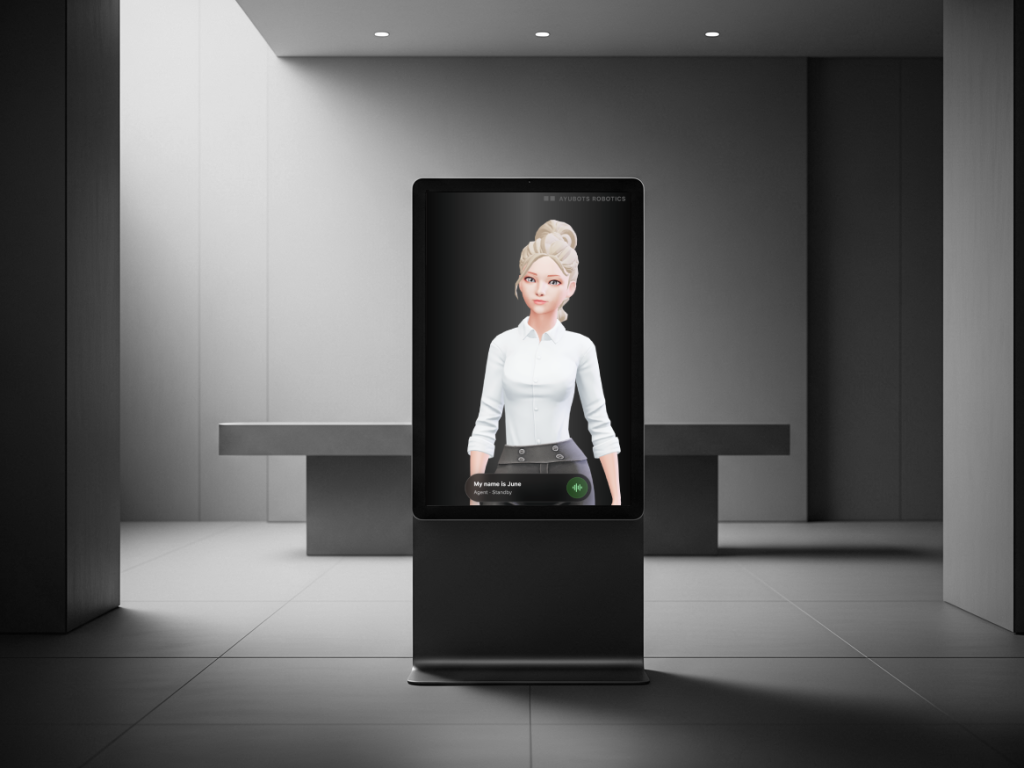
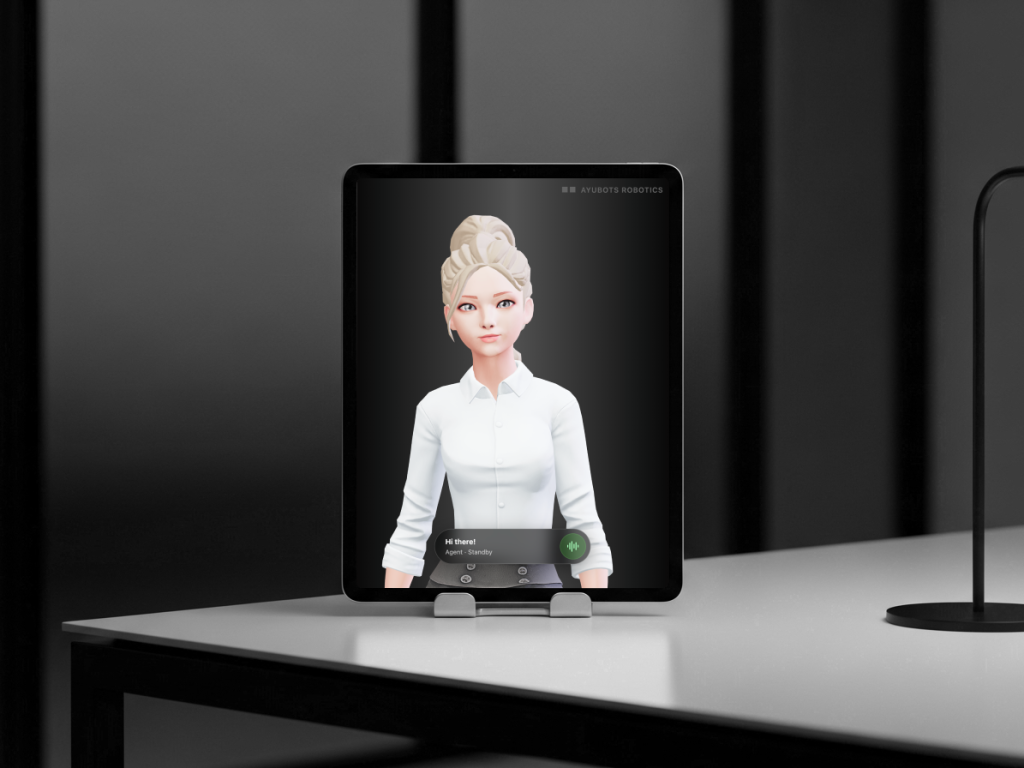
Spatial Agents by Ayubots Robotics is a platform that turns any screen into an AI-driven, conversational agent. It’s designed to be the brain and face for your digital signage, kiosks, tablets, and interactive displays. It’s not just an evolution of digital signage; it’s a new category.
More Than a Chatbot: Lifelike, Human Interaction
When you use Spatial Agents, you’re not getting a text box. You get a fully animated 3D avatar. These agents have real personalities (they are even based on the real people on our team!). They use natural gestures and expressions to create a genuine, friendly interaction that builds trust and keeps customers engaged.
The Agent That Learns on the Job
This is our secret sauce. You don’t need to be an AI engineer to use Spatial Agents. Our agents “learn from you.” You onboard them just like a new human employee. You give them documents, show them your website, or just talk to them about your business. The AI then trains itself by asking you questions to build its expertise. It’s the only AI that gets smarter with you.
A True Polyglot: Instant Multilingual Support
Our agents speak and understand 8+ languages right out of the box, including English, Spanish, French, German, Japanese, Arabic, and more. An agent can be helping a customer in Portuguese and then, seconds later, answer a different customer in Hindi. This is how you provide truly inclusive, human-level service to a global audience.
Not Just Talk: Integrated Actions
An advanced agent needs to do more than just talk. Spatial Agents can perform real tasks. They can generate a QR code on the screen to send a visitor a map, a form, or your contact info. They can pull up links, show product videos, and be extended with “Agent Apps” to add new skills, like checking inventory or booking appointments.
How to Implement Your Own Advanced Digital Signage
Ready to move beyond the slideshow? Upgrading to an AI-powered system is more straightforward than you might think.
Step 1: Define Your Goal (The “Why”)
First, what problem do you want to solve?
- Automating your reception desk?
- Providing 24/7 product expertise in your store?
- Offering multilingual wayfinding at an event?
Your goal will define the agent’s “job” and the knowledge it needs to learn.
Step 2: Choose Your Hardware (The “Where”)
The beauty of modern software is hardware flexibility. Spatial Agents is web-based and runs on almost any modern device.
- Tablets/iPads: Perfect for one-on-one, personal interactions at a help desk or concierge stand.
- Touchscreen Kiosks: Ideal for high-traffic areas like lobbies, mall entrances, or trade show booths.
- Custom Setups: Want to wow people? Spatial Agents can run on interactive projections, video walls, and custom-built displays.
Step 3: Onboard Your AI (The “What”)
This is the training part. With traditional software, this would mean complex coding. With Spatial Agents, it’s a conversation. You sign up, create your agent, and start teaching it. You can upload FAQs, product manuals, or just have a chat. The agent will tell you what it knows and what it doesn’t know, making training fast and intuitive.
Step 4: Deploy and Iterate
Once your agent has its base knowledge, you deploy it to your device. The journey doesn’t end there. The agent continues to learn from real customer interactions, and you can update its knowledge at any time, just by talking to it.
Conclusion: The Sign of the Future is Here Today
We’ve come a long way from digital posters. The most advanced digital signage software is no longer about passively displaying media. It’s about actively engaging, understanding, and helping people.
It’s defined by its intelligence, its ability to hold a natural conversation, and its power to serve anyone in any language. This new standard delivers a “human-level” experience at scale, improving engagement, increasing sales, and boosting efficiency with a clear ROI.
This technology is no longer a concept. It’s a real, available product.
You can start building your first AI-powered digital agent today. Spatial Agents is available now, and you can get started with a free trial to see just how powerful a conversation can be. Stop just displaying information. It’s time to start a conversation.