
The Universal Frustration of Getting Lost Indoors
Let’s be honest: we’ve all been there. You’re navigating a sprawling hospital, a multi-level shopping mall, or a vast corporate campus. You look for a directory, find that glowing “You Are Here” dot, and try to trace a path to your destination. You nod, start walking, and within thirty seconds, you’re second-guessing that first turn. Traditional indoor wayfinding is, for the most part, fundamentally broken.
For a world that has mastered global navigation with GPS that fits in our pockets, it’s baffling how difficult it is to find a specific store, a meeting room, or a patient’s wing. We’ve tried static maps, color-coded lines on the floor, and even clunky touchscreen floor plans. Yet, the most reliable method remains finding a human employee and asking, “Excuse me, how do I get to…?”
But what if your guide wasn’t a busy employee? What if it was a friendly, intelligent AI that could give you simple, verbal directions just like a person would? The problem isn’t just the maps; it’s the entire approach. It’s time we explored why these old methods fail and what the future of visitor guidance, powered by AI for wayfinding, really looks like.
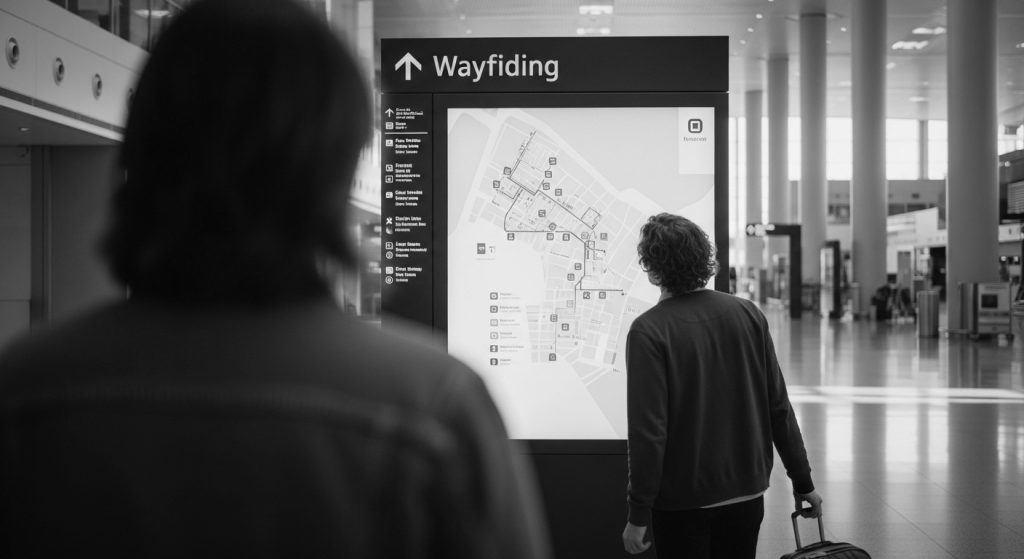
The Downfall of Traditional Indoor Wayfinding
Before we fix the problem, we have to understand exactly why current solutions are so frustrating. It boils down to a fundamental mismatch between how maps present information and how our brains process directions.
Static Maps: The “You Are Here” Fallacy
The classic wall-mounted map is the most common offender. Its biggest flaw is that it demands significant mental effort from the user.
- Cognitive Load: You have to find your location, find your destination, and then mentally rotate the entire map to match your physical orientation.
- Memory Game: The map shows you the entire path at once. You’re forced to memorize a complex sequence of turns: “Okay, left at the main corridor, then second right, past the two elevators, then a left…” Most people forget the route before they even take the first step.
- Outdated Information: These signs are expensive to replace. When a store moves or a department is renovated, the map instantly becomes a source of misinformation, leading to even more confusion.
The False Promise of Touchscreen Kiosks
Digital kiosks seemed like the high-tech answer. They are interactive, can be updated, and often show a glowing line from point A to pointB. So why do people still walk right past them?
- Unfamiliar UI: Every kiosk has a different, often clunky, interface. Users don’t want to learn new software just to find a restroom. They tap impatiently, get confused by the zoom and pan functions, and give up.
- The Same Memory Problem: A glowing line on a screen is just a digital version of the static map. It still requires the user to memorize the path. They walk away from the kiosk and are immediately back to relying on memory.
- Accessibility Gaps: These visual-only maps are useless for visually impaired guests. They also rarely cater to non-native speakers, creating an immediate barrier for international visitors or diverse communities.
Why We Still Just Ask a Person
There’s a reason we seek out a security guard or receptionist. Human interaction is the gold standard for directions. Why?
- It’s Conversational: You ask a simple question.
- It’s Contextual: The person gives you directions from where you are both standing.
- It’s Simple: A person doesn’t show you a complex blueprint. They give you step-by-step, digestible instructions. “Walk straight down this hallway until you see the big fountain. Take a right, and it will be the third door on your left.”
The problem is, human staff are busy, expensive, and not available 24/7. The ideal solution would combine the simplicity of asking a person with the reliability and availability of technology.
The Rise of AI for Wayfinding: A Smarter Path Forward
This is where AI for wayfinding changes the game. Instead of trying to build a better map, this new approach scraps the map entirely and focuses on a better conversation.
Imagine a visitor walking up to a kiosk or a tablet in your lobby. They don’t have to tap through menus. They just ask, in their own language, “Hi, I’m looking for the maternity ward.”
An AI-powered guide doesn’t just show them a blue line. It responds verbally with simple, human-like instructions, relative to its own position. “Of course! From here, walk straight ahead past the coffee shop. Take the main elevator on your right up to the 3rd floor. When you exit, the maternity ward will be directly in front of you.”
This conversational approach solves all the problems of traditional indoor wayfinding.
- There’s no map to rotate.
- There’s no complex path to memorize.
- It’s as easy and intuitive as talking to a person.
Meet Spatial Agents: Your AI-Powered Indoor Navigator
This future isn’t theoretical. It’s precisely what we’ve built with Spatial Agents. We designed a B2B SaaS platform that transforms any screen into a lifelike, AI-driven customer service agent that can act as an expert indoor navigator.
Spatial Agents by Ayubots Robotics are designed from the ground up to fix the failures of traditional wayfinding by being fundamentally human-like.
More Than a Map: A Conversational Guide
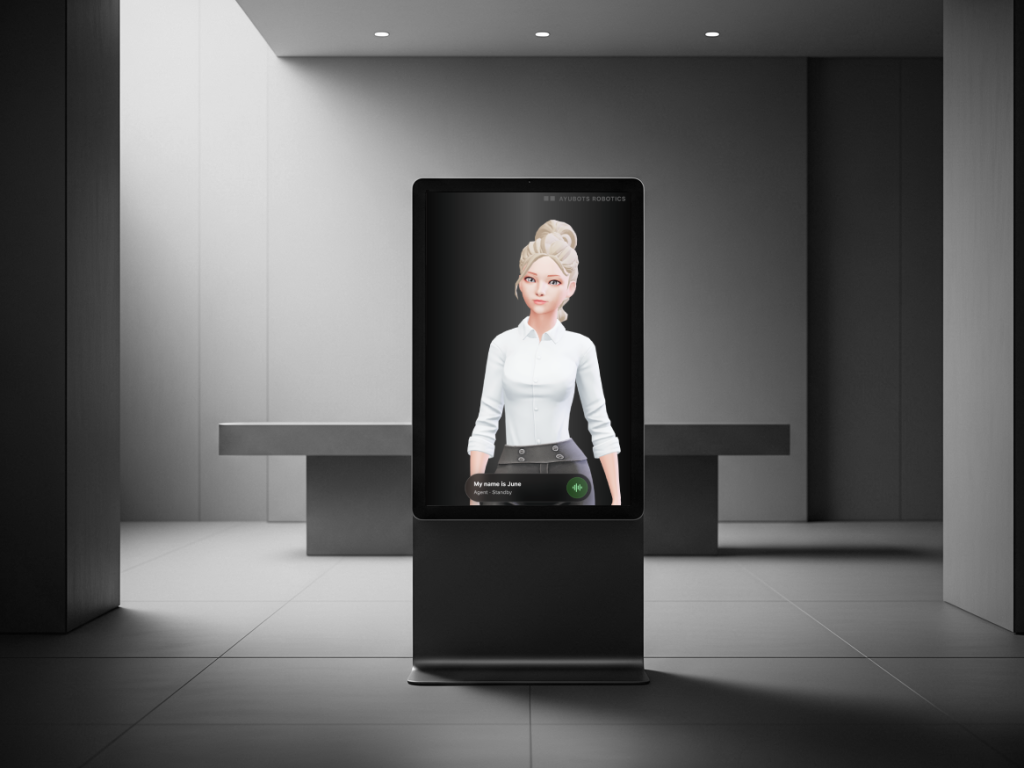
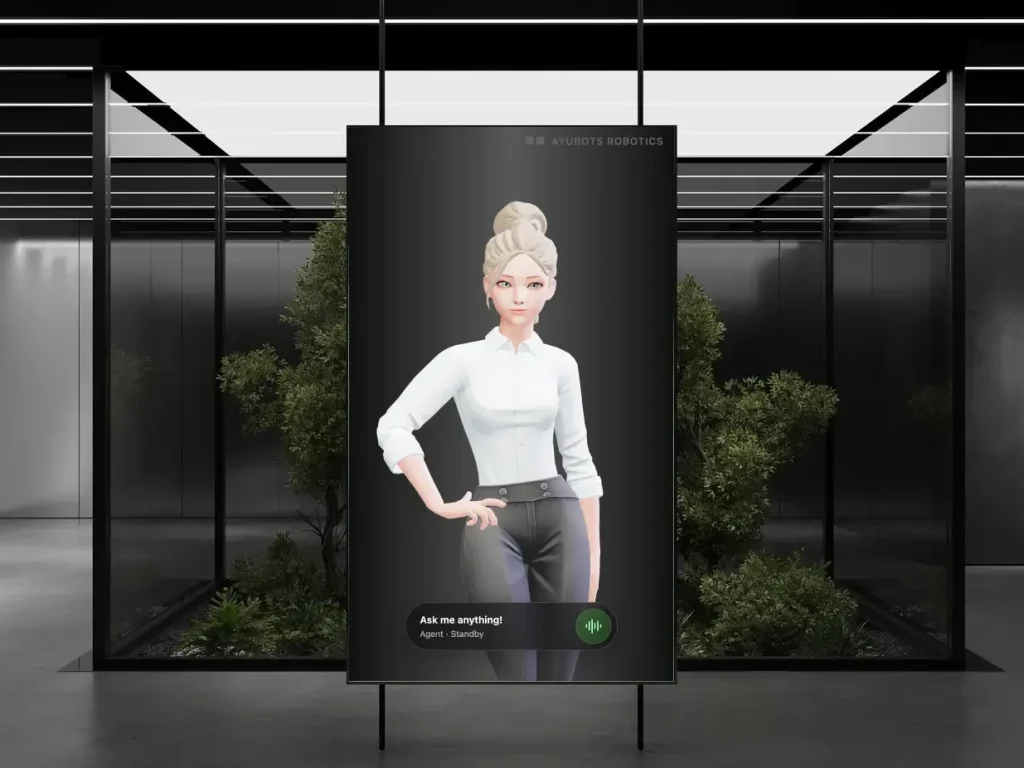
When you place a Spatial Agent in your building, it becomes your virtual concierge. Customers interact with a lifelike, animated 3D avatar that uses natural gestures and expressions.
It’s not a cold, robotic chatbot. It’s a friendly, welcoming presence. Thanks to advanced speech recognition and natural language processing, it understands and responds just like a friendly expert. A user can ask, “Where’s the nearest exit?” or “How do I get to meeting room 3B?” and get an instant, simple, verbal answer.
Context-Aware and Always Learning
The most powerful feature of a Spatial Agent is that it knows where it is. Its directions are always contextual. But more importantly, it learns your business just like a real employee.
You don’t need to be a developer to “program” it. You train it. Using a simple backend, you teach the agent about your building’s points of interest, products, and processes. The agent even asks you questions to fill in gaps in its knowledge, building expertise over time. You can teach it, “The ‘Ocean Room’ is our main conference hall. To get there from the lobby, go down the main hall and take the last left.” The agent learns this and can recall it for any visitor.
Breaking Down Barriers in Your Building
What about international visitors? Traditional signs are a huge barrier. Spatial Agents are instantly multilingual, fluent in over 8 languages like English, Spanish, French, German, Japanese, Arabic, and more.
A visitor from another country can walk up and ask a question in their native language and get a helpful, spoken reply in that same language. This makes your space welcoming and accessible to everyone, dramatically improving the visitor experience for a diverse clientele.
Doing More Than Just Talking
A Spatial Agent can also perform actions. After giving verbal directions, it can say, “Would you like me to send a map to your phone?” It can then generate a unique QR code on its screen. The visitor scans it and gets a simple map or link, bridging the gap between verbal directions and a digital takeaway.
Real-World Applications: Where Conversational Wayfinding Shines
This conversational approach to indoor wayfinding is a game-changer for any complex public space.
- Hospitals and Healthcare: The hospital environment is often high-stress. A confused patient looking for the radiology department doesn’t want to solve a map puzzle. A friendly AI agent at the entrance can provide clear, empathetic directions, reducing anxiety and improving patient flow.
- Shopping Malls and Retail: “Where can I find running shoes?” or “Where is the food court?” An AI agent can not only provide directions to a store but also act as a product expert, increasing sales and engagement.
- Hotels and Hospitality: Instead of a long line at the front desk, guests can ask a virtual concierge in the lobby how to find the pool, the gym, or their conference room. It provides 24/7 assistance and frees up human staff for more complex issues.
- Corporate Campuses and Events: For new employees, clients, or event attendees, navigating a large office building is a challenge. A digital receptionist can provide directions to meeting rooms, specific offices, or event check-in desks.
How to Implement Your Own AI Wayfinding Solution
The best part is that deploying this “future” tech is easier than you think. You don’t need to build a custom, expensive monolith.
Step 1: Rethink the Hardware
You don’t need proprietary hardware. Spatial Agents runs on almost any modern device with a web browser. This gives you incredible flexibility.
- Tablets/iPads: Use a simple tablet on a desk for a personal, one-on-one virtual receptionist.
- Touchscreen Kiosks: Place a larger standing kiosk in a high-traffic lobby for maximum visibility.
- Digital Signage: Convert any existing digital sign into an interactive guide.
Step 2: Focus on the “Brain,” Not Just the Map
The most important part is the software. With Spatial Agents, the platform is ready to go. Implementation isn’t about coding; it’s about training. You log in, give your agent a name, and start teaching it about your location. The self-learning system makes this intuitive.
Step 3: Test, Iterate, and Learn
Place your agent in a real-world location. Watch how people interact. The agent’s dashboard will show you what questions people are asking, allowing you to easily update its knowledge and make it even more helpful over time.
The Future of Indoor Wayfinding is Conversational
The “You Are Here” map is broken. Clunky touchscreen directories are a failed experiment. They don’t work because they fail to account for the simplest, most human way of getting information: a conversation.
The future of indoor wayfinding is not a better map; it’s a friendly, intelligent, and multilingual guide that is always available to help. It improves the visitor experience, reduces the burden on your staff, and makes your space accessible to everyone.
This technology is available to you today. Spatial Agents is the all-in-one platform to build, train, and deploy your own AI-powered navigators. You can stop confusing your visitors and start truly guiding them.
To explore how AI can revolutionize wayfinding in your business, you can try Spatial Agents for free by signing up on our site. You can start training your first agent in just a few minutes.