
In today’s world, customer expectations are higher than ever. We’ve all grown accustomed to instant answers from chatbots and the convenience of self-service touchscreens. But let’s be honest, something is often missing: the human touch. Tapping on sterile buttons or typing into a faceless chat window can feel cold and impersonal. What if we could bridge the gap between digital efficiency and human connection? This is precisely where the avatar kiosks comes in.
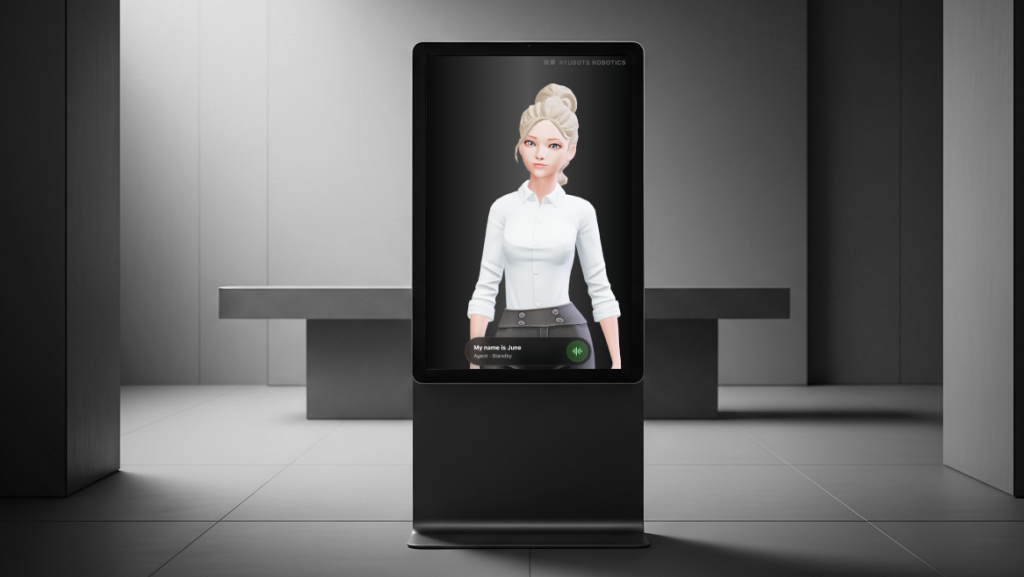
An avatar kiosk is not just another digital directory or a simple chatbot placed on a screen. It represents the next evolution of customer interaction. It’s a sophisticated system that combines artificial intelligence, natural language processing, and advanced graphics to create a lifelike, interactive “digital human” or “embodied agent” designed to help, inform, and engage with users in a way that feels surprisingly natural. In this article, we’ll explore exactly what an avatar kiosk is, the powerful purposes it serves, and real-world examples of how this technology is reshaping industries.
What Exactly is an Avatar Kiosk?
At its core, an avatar kiosk is a physical or digital station (like a tablet, a freestanding kiosk, or even digital signage) that features an animated, intelligent agent. Instead of you typing a query, you can simply speak to it. Instead of reading a wall of text, the avatar responds verbally, using natural gestures and facial expressions.
Think of it as the difference between texting a customer service agent and having a video call with a friendly, knowledgeable expert who is always on duty.
Beyond the Traditional Chatbot
The key differentiator is the “avatar” itself. A traditional chatbot is a disembodied intelligence; it’s just text in a box. An embodied avatar kiosk, as it’s often called, provides a visual presence. This is more important than it sounds. Psychologically, humans are wired to interact face-to-face. Seeing a “person” (even a digital one) that nods, smiles, and makes eye contact builds trust and makes the interaction more engaging.
This visual element moves the experience from a simple transaction (getting an answer) to an interaction (having a conversation).
How Do They Work? The Core Technology
An avatar kiosk is a symphony of several advanced technologies working together:
- Artificial Intelligence (AI) & NLP: This is the “brain.” The AI uses Natural Language Processing (NLP) to understand what you’re saying, no matter how you phrase it. It processes your intent, finds the correct information, and formulates a natural, conversational response.
- Speech Recognition: High-fidelity microphones capture your voice, and sophisticated software transcribes it into text for the AI to analyze. This needs to be fast and accurate, even in noisy environments.
- Animation & Graphics Engine: This is the “face” and “body.” This system renders the 3D avatar in real time. When the AI generates a response, the graphics engine animates the avatar’s facial expressions and body language to match the tone and content, making the conversation feel genuine.
- The Hardware: This is the physical shell. It can be as simple as an iPad on a counter or as complex as a large, custom-built touchscreen kiosk or interactive video wall. The key is that it includes a screen, a speaker, and a microphone.
The Driving Purpose: Why Businesses Need Avatar Kiosks
So, why are businesses in retail, hospitality, healthcare, and corporate environments so interested in this technology? The “purpose” of an avatar kiosk boils down to delivering a superior experience that traditional solutions just can’t match.
Delivering a Human-Like Connection at Scale
An avatar kiosk provides the empathy and approachability of a human employee combined with the scalability and efficiency of AI. You can have one “agent” or one hundred, all offering the same level of perfect, patient, and friendly service, 24/7. This consistency is a massive win for brands. Platforms like Spatial Agents even base their avatars on real people, giving them unique personalities and gestures that make interactions feel authentic, not robotic.
Overcoming Language Barriers Instantly
In a globalized world, communication is key. An airport, hotel, or major retail store serves customers from all over the world. A human employee might speak one or two languages. An advanced avatar kiosk can be multilingual.
For example, a solution like Spatial Agents can understand and speak over 8 languages (like English, Spanish, French, German, Japanese, Arabic, and Hindi) instantly. A visitor can walk up, speak in their native language, and the avatar will understand and reply in that same language. This is a game-changer for inclusivity and customer comfort.
24/7 Availability and Unwavering Efficiency
Avatar kiosks don’t need breaks, vacations, or sleep. They are the perfect solution for providing 24/7 help-desk support, after-hours reception, or information in places like hospitals or transportation hubs. They can patiently answer the same repetitive questions hundreds of times a day (“Where is the restroom?”, “What’s the wifi password?”) with a friendly attitude, freeing up human staff to handle more complex, high-value tasks.
Providing More Than Just Answers
Modern avatar kiosks are not just talking heads; they are integrated digital assistants. They can perform actions to actively help the user.
- Need to share a map? The agent can display it on the screen.
- Want a link to a feedback form? The agent can generate a QR code for you to scan with your phone.
- Need to see a product page? The agent can pull up the website link directly.
This ability to do things makes them practical tools, not just novelties.
Real-World Examples and Use Cases for Avatar Kiosks
The versatility of avatar kiosks means they can be deployed in almost any industry. Here are a few common examples:
- Retail & Malls: An avatar can act as a product expert, answering detailed questions about electronics or clothing. They can also serve as wayfinding guides (“Where is the nearest coffee shop?”), giving directions on an interactive map.
- Hospitality (Hotels & Resorts): A virtual concierge avatar can greet guests, provide information about hotel amenities, recommend local attractions, and handle simple requests, all in the guest’s preferred language.
- Corporate Lobbies: An AI virtual receptionist can manage visitor check-in, notify employees of their guest’s arrival, and answer common questions about the building, providing a sleek, modern first impression.
- Healthcare (Hospitals & Clinics): Avatars can handle patient intake and information, guiding them through forms and answering logistical questions (e.g., “Where is the radiology department?”), reducing front-desk congestion.
- Events & Trade Shows: An interactive avatar at an information booth can provide schedules, speaker information, and exhibitor locations, engaging attendees and gathering leads.
- Transportation (Airports & Train Stations): A multilingual avatar kiosk is the perfect information guide, providing real-time updates on departures, gate changes, and security procedures.
Spatial Agents: The Simple Path to Your Own Avatar Kiosk
Reading about this technology, you might be thinking, “This sounds amazing, but it must be incredibly complex and expensive to build.” In the past, it was. It required teams of AI developers, 3D artists, and hardware engineers.
Today, B2B SaaS platforms like Spatial Agents by Ayubots Robotics have made this powerful technology accessible to any business.
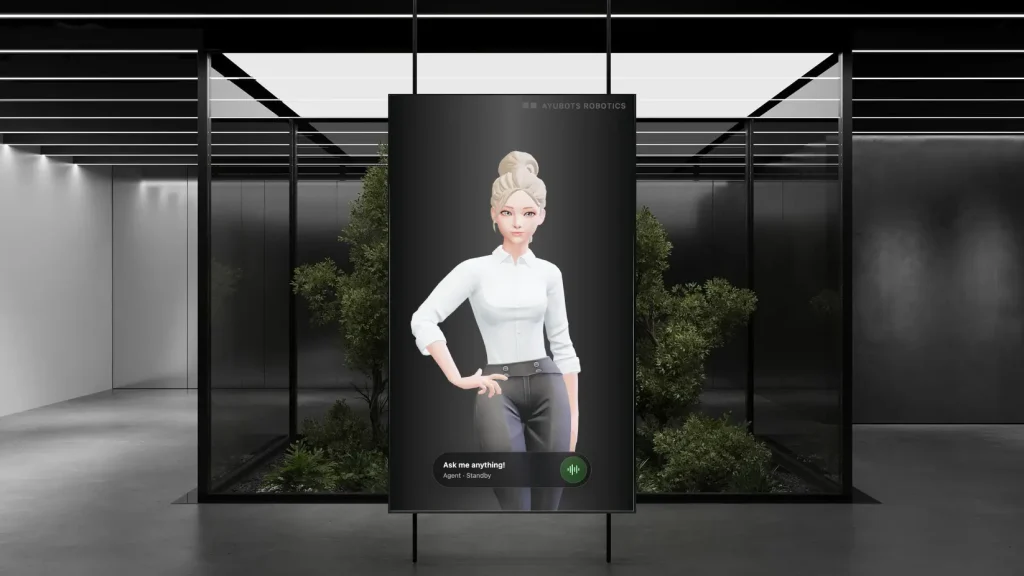
Spatial Agents is a platform specifically designed to create and deploy these lifelike, AI-driven customer service agents. It effectively provides you with an “AI-kiosk-in-a-box” that you can run on almost any modern device.
Meet Spatial Agents: Your AI Customer Service Team
Instead of building from scratch, Spatial Agents provides the complete solution. You get the animated 3D avatars, the advanced conversational AI, and the management tools all in one package. You can deploy your agent on a simple iPad for one-on-one interactions or on a large touchscreen kiosk for high-traffic areas.
What Makes Spatial Agents Different?
What sets a platform like Spatial Agents apart is its focus on making the AI genuinely human-like and incredibly easy to use.
- Effortless Self-Learning: This is perhaps the most powerful feature. You don’t need to be an AI programmer to “train” your agent. Spatial Agents learns from you. It literally asks you questions about your business, products, and processes, building its expertise over time just like a new employee would. You just talk to it.
- Truly Lifelike Avatars: These aren’t 2D cartoons. Spatial Agents uses realistic, animated 3D avatars based on real people. They use natural gestures and expressions, making the interaction feel authentic and engaging.
- Instant Multilingual Support: As mentioned, the platform supports over 8 languages out of the box. You can instantly serve a global audience without any extra development.
- Actionable & Extendable: The agents can do more than talk. They can generate QR codes, display links, and be extended with “Agent Apps” to add new skills tailored to your business, like booking appointments or connecting to your product database.
- Run on Any Device: Because Spatial Agents is web-based, it runs on almost any modern device with a browser. This gives you incredible flexibility, from tablets and kiosks to interactive projections.
Getting Started: Best Practices for Implementation
If you’re considering an avatar kiosk for your business, here are a few best practices to ensure success.
1. Define Your Goal
First, clearly identify the problem your avatar kiosk will solve. Is it to reduce wait times at reception? To provide 24/7 information? To increase sales by acting as a product expert? A clear goal will guide your entire setup.
2. Choose the Right Hardware
Where will your agent live? A small tablet on a desk is perfect for a virtual receptionist. A large, freestanding kiosk is better for a high-traffic mall lobby. With a flexible platform like Spatial Agents, you can choose the hardware that fits your space and budget.
3. Train Your Agent (The Easy Way)
This is the most critical step. Your agent is only as good as its knowledge. In the past, this meant creating complex flowcharts and scripts. But with a self-learning system, “training” is just a matter of having conversations with your agent and providing it with your business documents. It learns and improves every day.
4. Test, Iterate, and Learn
Once deployed, watch how people interact with it. Are they asking questions you didn’t anticipate? Use these insights to continue training your agent. The best avatar kiosk is one that continuously evolves with your business needs.
The Future is Friendly
The avatar kiosk is more than just a trend; it’s a fundamental shift in how we interact with technology in public and commercial spaces. It takes the cold, impersonal nature of digital service and infuses it with personality, empathy, and intelligence.
By blending the best of human-like interaction with the power of AI, these agents are solving real-world business challenges: they improve customer engagement, provide invaluable 24/7 multilingual support, and free up human teams to focus on what they do best.
This technology is no longer science fiction. Platforms like Spatial Agents have made it a practical and affordable reality for businesses of any size. To explore the power of an avatar kiosk for your business, you can get started with Spatial Agents for free and begin training your first digital employee today.